


Trump’s Gaza Plan
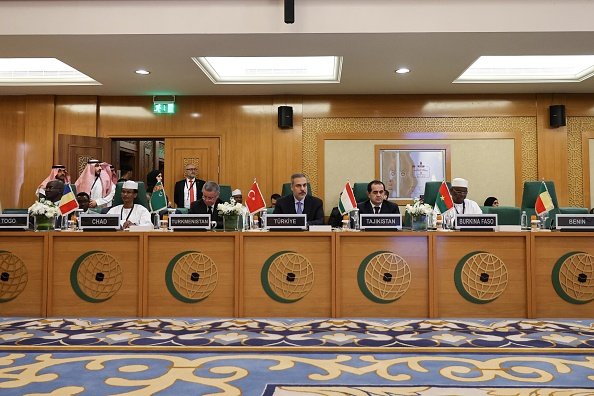
JEDDAH: The Organisation of Islamic Cooperation (OIC) has formally endorsed an alternative plan proposed by the Arab League in response to U.S. President Donald Trump’s highly controversial idea of taking over Gaza and relocating its residents. This endorsement was finalized during an emergency meeting held in Jeddah, Saudi Arabia, on Friday, according to statements from Egyptian and Sudanese officials.
The 57-member OIC’s decision follows the Arab League’s ratification of the plan during a summit in Cairo earlier in the week. The counter-proposal, crafted primarily by Egypt, envisions the reconstruction of Gaza under the administration of the Palestinian Authority rather than any external force.
Egyptian Foreign Minister Badr Abdelatty welcomed the OIC’s endorsement, stating that the plan has now evolved into an “Arab-Islamic plan.” His Sudanese counterpart echoed this sentiment, emphasizing that the proposal aligns with regional efforts to prevent the forced displacement of Palestinians from Gaza.
Trump’s initial proposal sparked widespread international condemnation after he suggested that the U.S. should take control of Gaza and transform it into what he described as the “Riviera of the Middle East.” The plan also included the forced relocation of Palestinians to Egypt or Jordan, an idea that drew fierce criticism from Arab and Muslim nations.
At the Cairo summit, Arab leaders not only rejected Trump’s proposal but also announced the establishment of a trust fund aimed at financing Gaza’s reconstruction. They urged the global community to support this initiative, calling on international powers to back their efforts.
Abdelatty stressed that the next step for the Arab-Islamic plan is to gain broader international approval, including potential endorsement from the European Union, as well as key global players such as Japan, Russia, and China. He confirmed that diplomatic efforts are already underway to engage various stakeholders, including the U.S. government.
Despite the Arab League’s and OIC’s support, the counter-proposal has faced opposition from both the United States and Israel. The U.S. State Department, through spokeswoman Tammy Bruce, stated that the plan “does not meet the expectations” of Washington. Meanwhile, Trump’s Middle East envoy, Steve Witkoff, provided a slightly more measured response, calling it a “good-faith first step from the Egyptians.”
A key point of contention in the proposal is its lack of a role for Hamas, which currently governs Gaza. While the Arab League and OIC aim to shift control to the Palestinian Authority, Hamas has not been included in the framework, which could present challenges in implementation.
Egyptian political analyst Rabha Seif Allam of the Al-Ahram Center for Political and Strategic Studies noted that Cairo is actively working to build a broad coalition in opposition to the displacement of Palestinians. She emphasized that Egypt’s efforts seek to secure global support while countering Trump’s controversial approach.
In addition to the Gaza plan, the OIC meeting also saw the reinstatement of Syria, which had been suspended from the organization in 2012 due to the civil war under President Bashar al-Assad. The Syrian foreign ministry welcomed this development, calling it a significant step toward reintegrating Syria into the regional and international community as a “free and just state.”
With tensions high in the region, the coming weeks will likely determine how much traction the Arab-Islamic plan can gain on the global stage and whether diplomatic efforts will succeed in countering Trump’s takeover proposal.
