

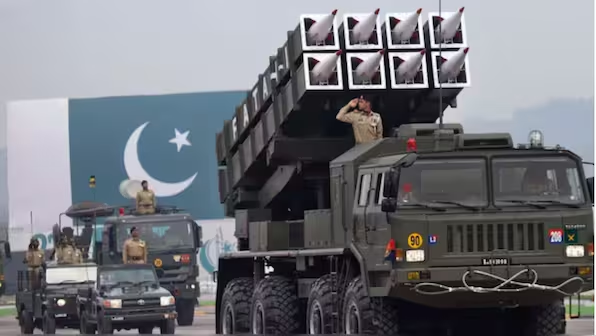

Military Budget
ISLAMABAD: Amid rising tensions with India and increasing security demands, Pakistan is weighing a substantial increase in its proposed defence budget for the upcoming fiscal year, beyond the initially agreed 18% rise.
Officials involved in the discussions told that national security imperatives may now require a hike of up to 25%, translating into an additional Rs500 billion.
The development follows India’s recent military aggression and proxy attacks, including a deadly school bus bombing in Balochistan, which Pakistani authorities have directly blamed on Indian-backed elements. With these escalations, the urgency to replenish military stockpiles, enhance indigenous defence research, and address past liabilities has intensified.
Preliminary allocations had set the defence budget at Rs2.48 trillion—an 18% increase over last year’s Rs2.1 trillion, and more than the IMF’s suggested 12% increase to Rs2.42 trillion.
While the International Monetary Fund (IMF) has shown flexibility on higher defence spending, it insists Pakistan maintain its primary budget surplus target of 1.7% of GDP (about Rs2.2 trillion), making fiscal space essential.
To meet the added requirements, the Finance Ministry is exploring multiple funding avenues, including the reallocation of unproductive subsidies—particularly from the power sector and banking schemes. Notably, the IMF has raised concerns about over Rs1 trillion in electricity subsidies, despite falling energy prices.
Federal officials are also urging provincial governments to share the additional defence burden. Petroleum Minister Ali Pervaiz Malik has argued that since Indian attacks have impacted Punjab and Sindh directly, provinces should contribute at least half of the increased defence costs. With provinces sitting on cash surpluses, Islamabad sees this as a fair demand.
Meanwhile, coalition partners are pushing for an increase in the Public Sector Development Programme (currently proposed at Rs921 billion), further straining federal resources. The Finance Ministry, however, prefers prioritizing defence.
This budget debate occurs as the Federal Board of Revenue (FBR) faces criticism for consistently missing tax targets, undermining national revenue projections. Additionally, recent IMF-FBR meetings reportedly ended in frustration due to FBR’s failure to meet key reform benchmarks.
As national security concerns mount, the government is expected to finalise a one-time exceptional increase in defence allocations to strengthen the army, navy, and air force in response to an increasingly volatile regional landscape.
