

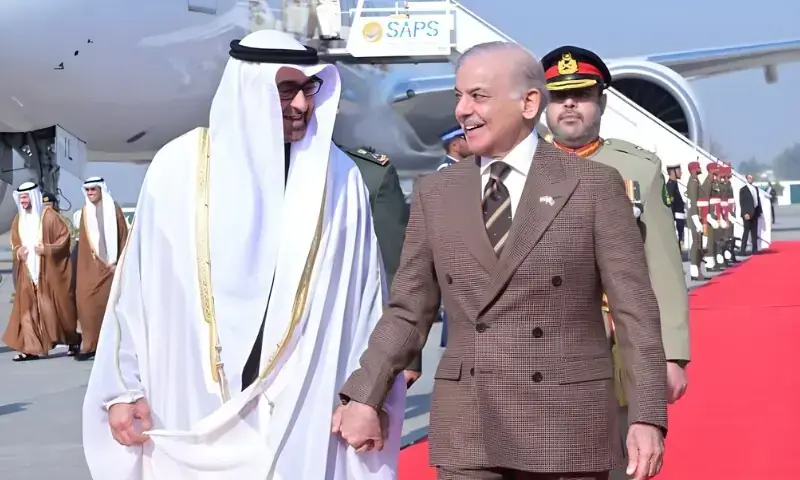

ISLAMABAD: The official visit of UAE President Sheikh Mohamed bin Zayed Al Nahyan to Pakistan on December 26, 2025, marked a significant strategic moment rather than a routine diplomatic engagement. As his first visit to Pakistan in his presidential capacity, the trip underscored Abu Dhabi’s view of Islamabad as a key strategic partner linking the Persian Gulf with South Asia.
Pakistan accorded Sheikh Mohamed bin Zayed an unusually high-level reception, including a JF-17 fighter jet escort, a 21-gun salute, and the presence of the prime minister, foreign minister, and army chief. Authorities also declared a local holiday in Islamabad, signaling Pakistan’s intent to highlight the UAE as a privileged and reliable partner amid regional competition for influence.
Economic Diplomacy at the Core
Economic cooperation emerged as the central pillar of the visit. Officials from both sides emphasized trade, energy, infrastructure, and information technology, reflecting a shift from short-term financial assistance toward long-term, targeted investment. The UAE has pursued a similar investment-driven model in Egypt, Jordan, and Turkey, seeking sustainable returns alongside political leverage.
For Pakistan, grappling with debt pressures and balance-of-payments challenges, the UAE’s financial capacity and centralized decision-making make it an especially attractive partner for foreign direct investment.
Security and Geopolitics in the Background
Security considerations also featured prominently, though largely behind closed doors. The visible role of Pakistan’s army chief and repeated references to regional stability pointed to quiet discussions on security cooperation. Abu Dhabi views stability in Pakistan as critical to broader Gulf security.
Regionally, the visit also carried geopolitical weight amid competition among Saudi Arabia, the UAE, and Turkey for influence in the Muslim world. Pakistan’s military strength and strategic location make it a pivotal actor in this contest.
A Broader Strategic Vision
Analysts view the visit as part of the UAE’s broader recalibration toward economic diplomacy while retaining strategic influence. In this evolving regional architecture, Pakistan stands as a central pillar rather than a peripheral partner.
