

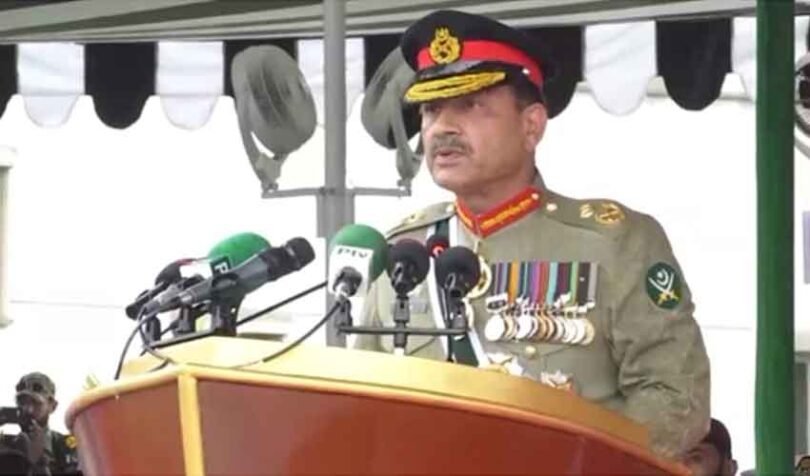

ISLAMABAD: Chief of Defence Forces and Army Staff Field Marshal Asim Munir has said that most militants entering Pakistan under the banner of the banned Tehreek-i-Taliban Pakistan are Afghan nationals. He stated that nearly 70 per cent of TTP formations infiltrating Pakistan comprise Afghans.
The army chief made these remarks during the National Ulema Conference held in Islamabad. Although full details of his address remained limited, television channels aired clips of his speech on Sunday.
Addressing religious scholars, Field Marshal Munir highlighted Pakistan’s long-standing concerns about cross-border militancy. He said Pakistan has consistently urged Afghan authorities to prevent terrorists from using Afghan soil. However, Kabul has repeatedly rejected these allegations.
Turning directly to the issue, the army chief posed a pointed question to the audience. He asked whether Afghanistan was not spilling the blood of Pakistani children. He said Pakistan had clearly conveyed its stance to the Afghan Taliban leadership.
According to Field Marshal Munir, Pakistan asked Kabul to make a clear choice. He said the Afghan Taliban were told to choose between Pakistan and the TTP. He stressed that continued ambiguity endangered regional stability.
Shifting focus, the army chief spoke about Pakistan’s recent military confrontation with India. He referred to Pakistan’s retaliatory operation, Bunyanum Marsoos, during the four-day conflict in May. He said the armed forces experienced divine help during the operation.
“We felt it,” he remarked, while describing the military response. He said national unity and faith strengthened the armed forces during the confrontation.
India launched multiple strikes in the early hours of May 7 across several locations in Pakistan. The strikes triggered the most intense military escalation between the two countries in decades.
Both sides used fighter jets, missiles, artillery, and drones during the fighting. The clashes lasted four days and resulted in dozens of deaths. Eventually, both countries agreed to a ceasefire.
The confrontation followed an attack on tourists in occupied Kashmir’s Pahalgam area on April 22. The attack killed 26 people and drew global attention. India blamed Pakistan for the incident without presenting evidence.
Pakistan strongly denied any involvement in the attack. The Foreign Office questioned the credibility of India’s narrative. It said India’s claims were filled with fabrications and inconsistencies.
Returning to broader ideological themes, Field Marshal Munir spoke about Pakistan’s role in the Muslim world. He said there were 57 Islamic countries globally. Among them, he said, Pakistan received the honour of protecting Haramain Sharifain.
He referred to the holy cities of Makkah and Madina. He described their protection as a sacred responsibility bestowed by God.
The army chief also drew historical parallels. He compared Pakistan with the first Islamic state established in Saudi Arabia 1,400 years ago. He said both states were founded for the same purpose.
He noted that both were established during the holy month of Ramazan. He also said migration played a key role in both foundations.
Furthermore, Field Marshal Munir addressed the sensitive issue of jihad. He said only the state holds the authority to declare jihad in an Islamic country. He rejected the legitimacy of non-state actors issuing such calls.
He stressed that no individual or group could issue a fatwa for jihad independently. According to him, such authority rests solely with those vested with constitutional power.
During his address, the army chief cited several verses from the Holy Quran. He used them to reinforce his arguments on state authority, unity, and religious responsibility.
Participants at the conference included leading religious scholars from across the country. Officials said the event aimed to promote harmony and counter extremist narratives.
Observers say the remarks signal Pakistan’s firm stance on militancy and sovereignty. They also reflect Islamabad’s growing frustration with unresolved cross-border security challenges.
