

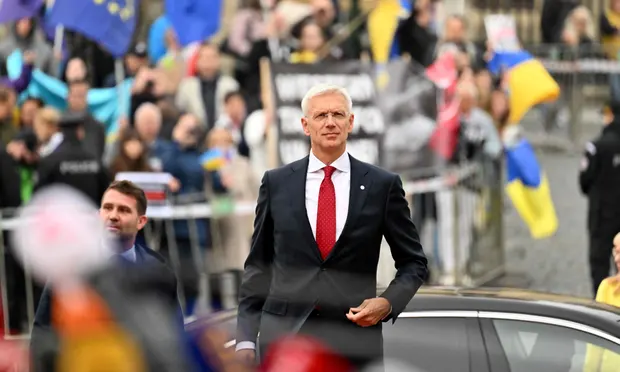

Krijnis Kari, the prime minister of Latvia, has urged EU leaders to halt all Russian tourist visas, reigniting the discussion of increasing sanctions against Vladimir Putin’s Russia.
Kari disputed the notion that letting Russians trying to avoid the draught to enter the EU would be a strategy to undermine the Kremlin’s military forces in an interview with the Guardian. He claimed that while it was reasonable that many men would not want to “go and fight and perhaps die in Ukraine,” this may result in a “potentially enormous surge of immigration coming from Russia,” and that this constituted a security concern to Europe. “I believe that the majority of political dissidents have already fled. Then there will be people acting for unknown motives and for economic gain, among many, many other things.
Together with Poland, its two neighbours on the Baltic Sea, and Finland, Latvia has closed to Russian tourists and has been pleading with the rest of the EU to follow suit, but to no avail. Because they worry it will prevent Russians who disagree with Putin’s government from leaving, France and Germany are reluctant to abolish tourist visas. Last month, the European Commission issued guidelines urging stricter security checks before awarding Russian visas.
For humanitarian reasons, Kari stated that it was “essential that we always maintain the side door open, but these need to be looked at on a case by case basis.” The Latvian capital of Riga is home to several prohibited independent Russian media sites, including the website Meduza and the TV channel Dozhd. The latter two were formed there in 2014 by a Russian journalist who had been fired for her coverage of the Crimea. The transmission of content from several of these sources into Russia is prohibited. In order for a free, non-Kremlin-dominated Russian press to continue to exist and broadcast in order to inform their fellow citizens, Kari said: “We have permitted and welcomed these people to work.”
A Latvian-American dual national born in Wilmington, Delaware, Kariņš leads Latvia’s center-right New Unity party, which came top in parliamentary elections last month, with 19% of the vote. He now hopes to form a coalition with the free-market National Alliance and left-leaning Progressives, parties that are aligned, he said, on an agenda of being “[pro-]Nato/EU, moving towards being climate-neutral, being independent of Russia, fully supporting Ukraine”.
The once-pro-Kremlin Harmony party lost the elections after failing to reach the 5% barrier needed to enter Latvia’s Saeima, which has 100 MPs. The party lost momentum because of its vehement condemnation of the Russian invasion, and anti-war voters chose mainstream parties. Latvia has 475,000 Russian-speaking voters, including Ukrainians and Belarusians.
According to Kari, there is no evidence of a social divide between the two linguistic groups. “The opposite appears to be taking place. The proportion of Latvian citizens and residents that favor Russia has been declining since the start of the conflict. A “gradual process of absorption into one, more cohesive community,” he claimed.
