

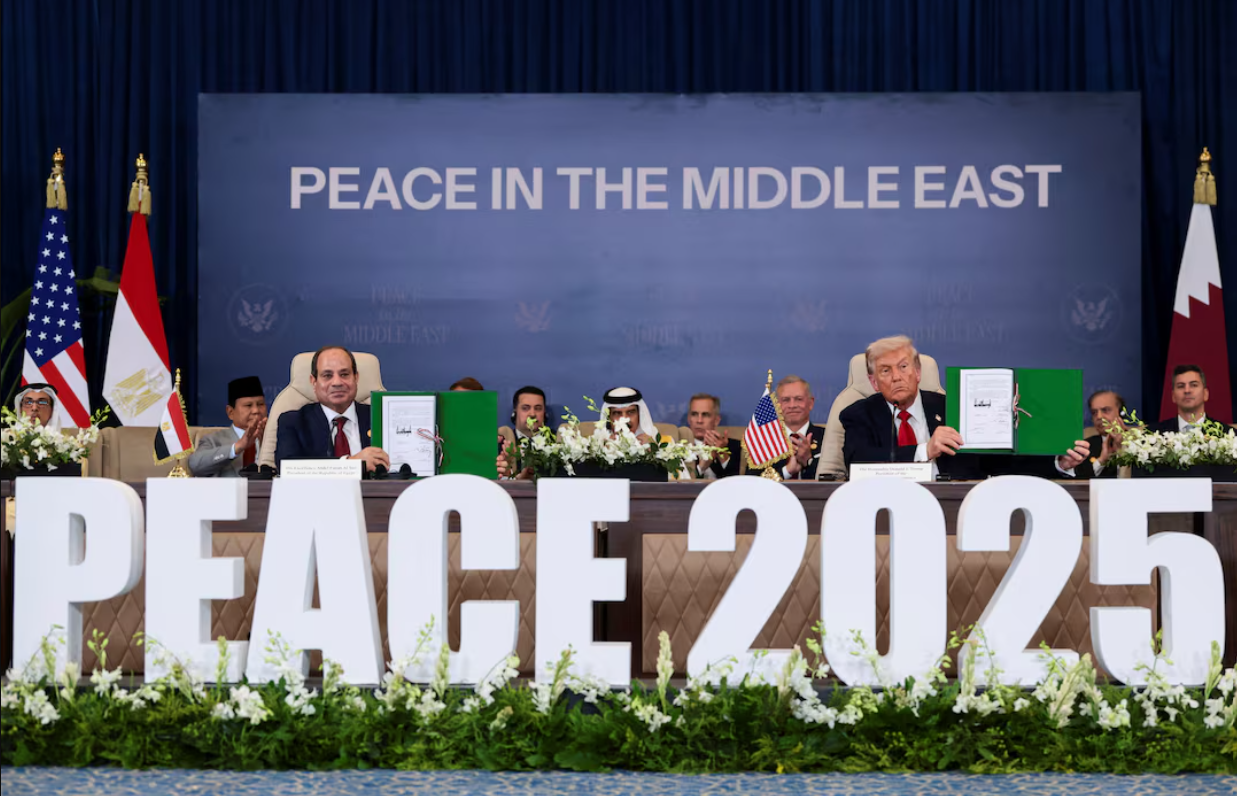

In a diplomatic breakthrough, the Gaza Peace Agreement was formally signed at the summit in Sharm el-Sheikh, Egypt, with participation from the United States, Egypt, Qatar, and Türkiye. The accord aims to institute a lasting ceasefire and lay foundations for reconstruction, cooperation, and renewed stability in Gaza.
At the signing ceremony, U.S. President Donald Trump described the occasion as “a historic day for the entire world.” He noted that the agreement is “very comprehensive,” setting out rules, principles, and pathways for peace, humanitarian relief, and regional coordination.
Trump on the Gaza Deal: “Difficult but Necessary”
Trump acknowledged the challenges that accompanied the negotiations. He said the Gaza peace deal ranks among the toughest he has led. He affirmed that perseverance, strong leadership, and international backing were critical to its success.
Jokingly, he added, “I like the tough people better than the soft, easy ones,” suggesting that hard bargaining was necessary to reach consensus. He also referenced financial backing, saying that many powerful sponsors stand behind the agreement and expressed gratitude for their support.
Summit Brings Global Leaders Together
More than 20 nations and leaders attended the summit, including representatives from Pakistan, Türkiye, Saudi Arabia, France, Britain, Italy, Indonesia, Azerbaijan, and Kuwait.
Egyptian President Abdel Fattah al-Sisi, the host, played a strong role in mediating the ceasefire. At the event, Trump praised Sisi’s role, calling it “crucial to this success” and characterizing him as a “wonderful figure.”
Trump also met with Palestinian President Mahmoud Abbas, Pakistani Prime Minister Shehbaz Sharif, Türkiye’s President Recep Tayyip Erdoğan, the British and Canadian prime ministers, and UN Secretary-General António Guterres. He emphasized the diversity and importance of international participation in stabilizing Gaza.
Credit to Egypt and Hamas for Cooperation
Trump acknowledged the constructive roles played by both Egypt and Hamas. He said Egypt’s mediation was indispensable and that Hamas also contributed toward making the truce possible. He extended thanks to all participants and reaffirmed his commitment to peace.
Looking Ahead: Reconstruction, Iran, and Phase Two
Turning to future challenges, Trump underscored the imperative of rebuilding Gaza. He noted the extensive damage and said “a lot of debris” must be cleared to restore infrastructure and livelihoods.
He also referenced Iran’s potential role, suggesting that Tehran has shown interest in dialogue and negotiations. Trump implied that future discussions could involve Iran engaging with the peace process.
He characterized this agreement as just the beginning, declaring that phase two of negotiations is already underway, and expressed optimism for a “new Middle East” emerging from this effort.
Implications and Next Steps
The Gaza Peace Agreement marks a high point in multilateral diplomacy focused on a region long affected by conflict. Its success depends on real-world implementation: enforcing the ceasefire, securing humanitarian access, rebuilding infrastructure, and maintaining political will among key actors.
Netanyahu’s absence from the summit—cited because of a Jewish holiday—adds complexity. Without Israel’s direct presence, follow-through and compliance might rely heavily on behind-the-scenes mechanisms and third-party guarantees.
As momentum now shifts from signing to execution, the international community will be watching closely. Whether this accord lays the path to lasting peace or faces obstacles from entrenched tensions remains to be seen.
