

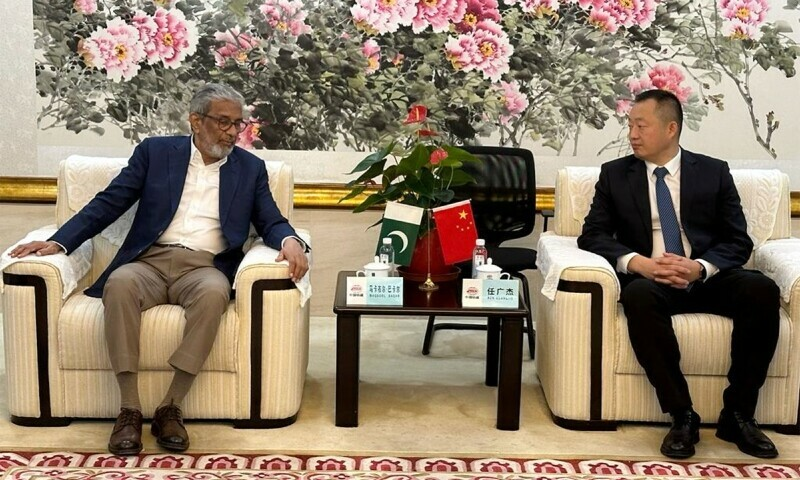

Interim Chief Minister, retired Justice Maqbool Baqar, and Vice President of China Railway Construction Company, Li Samaa, have reached an agreement to resolve issues related to the Right of Way (RoW) and the sovereignty guarantee to kickstart the long-awaited Karachi Circular Railway (KCR) project. This development emerged during discussions held on the sidelines of “The Third Belt and Road Forum for International Cooperation” in Beijing.
The Chief Minister discussed the Karachi Circular Railway project in detail with Mr. Li Samaa and assured him that the caretaker provincial government, along with the railway ministry, has been addressing RoW issues.
Justice Baqar explained that during a review meeting of the China-Pakistan Economic Corridor (CPEC) projects on February 9, 2023, they noted that the China Railway Authority required a fresh feasibility study based on Chinese standards to determine the funding and project cost of the KCR.
The Vice President of CRCC urged the Chief Minister to resolve the issues of RoW and secure a sovereign guarantee from the Pakistan government. Justice Baqar conveyed that the provincial transport department, in collaboration with CRCC, a state-owned company and one of the world’s largest construction groups completed the KCR feasibility study. However, the federal government has not issued a sovereign guarantee. The Sindh government, in coordination with the federal government, planned to approach Chinese authorities to expedite the KCR project.
The Planning Commission has also submitted the updated feasibility study to the China Railway Authority.
Reliable form of Transportation
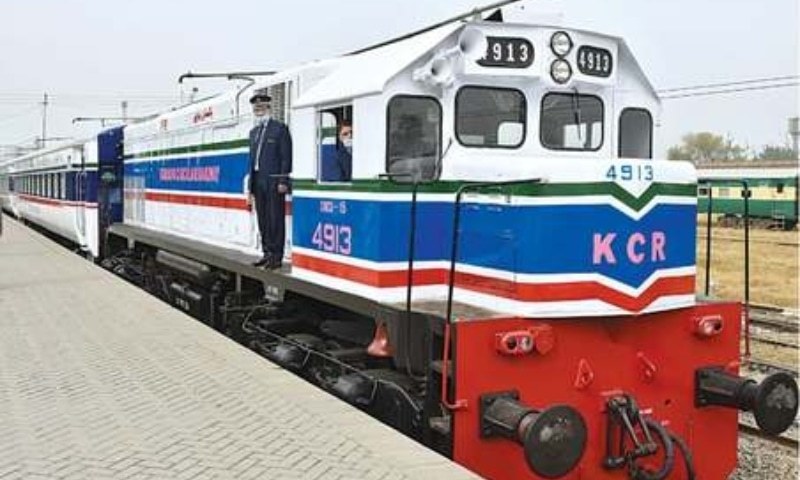
The KCR’s circular route spans approximately 43 kilometers, connecting various areas of Karachi, including industrial zones, residential neighborhoods, and commercial districts. It is a solution to reduce traffic congestion and combat air pollution by providing a reliable alternative to road transportation.
The KCR project has experienced changes in funding and execution modes due to political transitions, initially proposed as a Public-Private Partnership (PPP) project and later transitioning to Chinese investment under the China-Pakistan Economic Corridor (CPEC).
Work on the project has been initiated, but construction halted after the change in the government’s approach. The KCR project aims to create a 43.2-kilometer route, including elevated and on-ground sections, with 24 stations and a dual track equipped with 162 train sets. The KCR originally began in 1964 but ceased operations in 1999 after incurring losses.
