

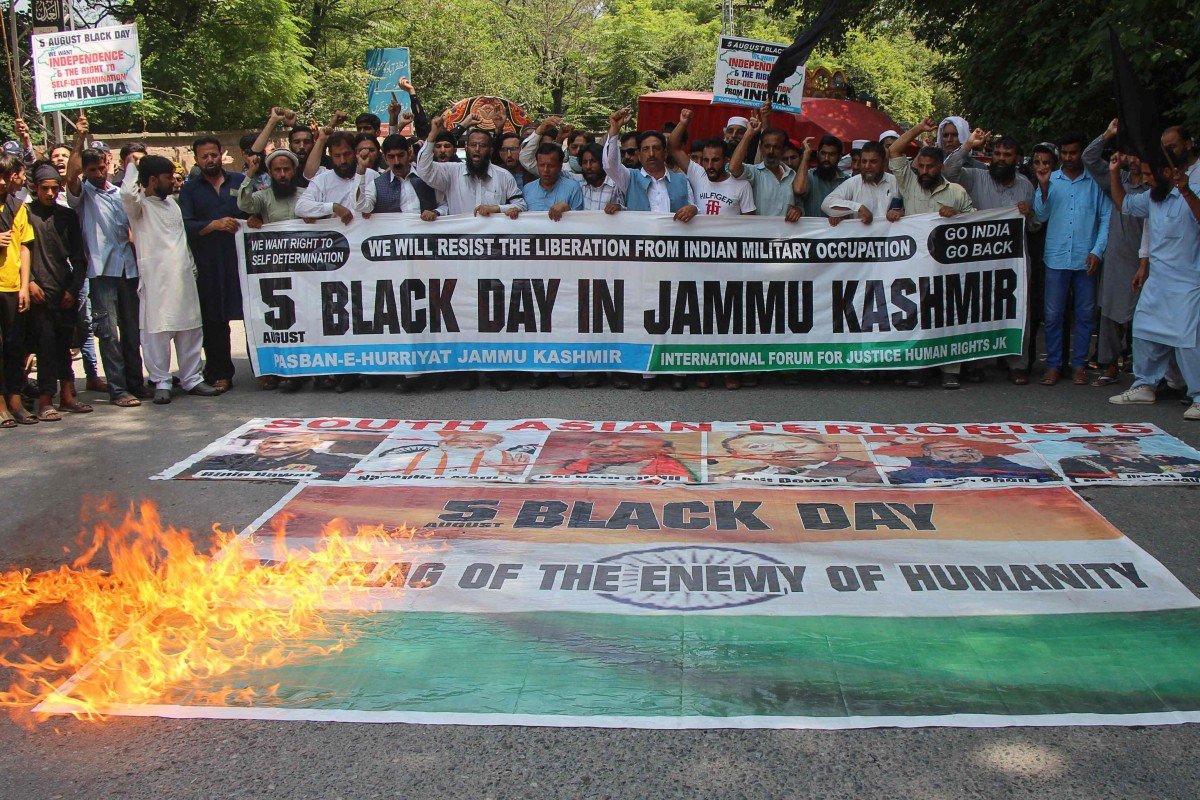

Two years after Narendra Modi’s brazen move to purportedly absorb the occupied territory of Jammu & Kashmir into Indian union, questions continue to swirl around Pakistan’s ambiguous policy position over the matter.
Why has a nuclear Pakistan failed to render any practical support to the beleaguered Kashmiris? Why has Pakistan’s Kashmir policy been reduced to symbolism like issuing statements, holding protest march- es, and so forth? Has Pakistan accepted India’s revocation of article 370 and 35-A on 5 August 2019 as a fait accompli? What about Islamabad’s principled support for the Kashmiris’ right to self-determination?
Meanwhile, India has unleashed a reign of terror in the occupied territory in the form of extrajudicial killings, siege and search operations. Pakistan’s symbolic move to mark 5 August as ‘Youm e Isthasal e Kashmir” (Day of exploiting Kashmir) has failed to have any impact on New Delhi or the world at large.
India’s shameless actions aiming to change the demography in the Muslim majority Valley of Kashmir by issuing thousands of domicile certificates to non-locals and patronizing the settlement of non-Muslims reflects India’s growing sense of confidence in the nefarious enterprise.
The Kashmir conference held under the auspices of Modi regime in New Delhi in this June nothing but a cunning move to find willing collaborators among the Kashmiri leadership.
“Two years after the Indian parliament revoked the autonomous status of Indian-administered Kashmir, Prime Minister Narendra Modi’s government seems to have succeeded at bringing the region under its direct authority”, said Anchal Vohra in an opinion piece carried by the Foreign Policy magazine.
The provocative title of the piece, carried on 3 August 2021, was, “Modi took complete control of Kashmir two years ago and got away with it”.
Vohra said: “When India first made its move, it startled the world and led to fears of a rise in violence in the valley and a potential open conflict with Pakistan, the nuclear-armed state that claims sovereignty over Kashmir in its entirety.
“New Delhi also got worried about the diplomatic fallout with the West as Pakistan joined China in pressuring India through the United Nations Security Coun- cil. But there has neither been a war with Pakistan nor eruption of large-scale violence in the valley. Even condemnation from the international community has been cautiously worded and limited.”
Does it mean that initial Indian concerns about an international pressure and surge of violence following its unilateral acts of 5 August 2019 were misplace? Has the Modi regime managed to crush popular resent- ment of Muslim Kashmiris living under its occupation, while keeping Pakistan from rendering practical support to the Kashmiris?
If Muslim Kashmiris are facing the threat of demographic transformation in the Muslim majority Valley they are no more engaged in an armed conflict with around half a million Indian forces and seem to have been tamed.
It is obvious that given India’s draconian hold, pro-Independence parties will not be able to pose any tangible challenge to India’s collaborators. Anyway, controlling the land and not the hearts of Kashmiri Muslims appears to be the priority for the Modi regime.
When Kashmiri leaders like Mahbooba Mufti and Farooq Abdullah asked Modi in the New Delhi conference to restore special status of J&K, Modi assured them that once the situation returns to normalcy, something can be done to meet the aspira- tions of Kashmiri people.
Meanwhile, petitions challenging the revocation of article 370 are pending in the Indian Supreme Court for long with little likelihood of the 5 August 2019 acts being reversed through a judicial verdict.
Claims Vohra: “India has undoubtedly defeated Pakistan in this bout of their prolonged and intractable conflict. Islamabad fumbled while New Delhi rallied quiet support from the Western world and even brought the United Arab Emirates and Saudi Arabia to temper Pakistan’s expectations.
“The UAE has acknowledged it played a role in getting the two rivals to agree to a cease-fire. Over the last two years it has also become clear that Indian diplomats have crushed Pakistan’s hopes of a UN-led plebiscite to settle the Kashmir dispute. But that does not mean India has eliminated all challenges”.
Does it mean that Pakistan’s Kashmir policy which is based on two major compo- nents to restore the status of Jammu & Kashmir to pre-5 August 2019 position and the resolve the Kashmir issue according to the UN Security Council resolution of 1948 and 1949 has been a failure?
One can figure out two major reasons for why Pakistan’s Kashmir policy has failed to produce positive results. The first of these is the total lack of will and determination on the part of elites to render sacrifices for the cause of Kashmir.
When J&KLF in October 2019 announced that it plans to march towards Line of Control to express their solidarity with their compatriots holed up in the Indian occupied Valley, they were not allowed to proceed.
Islamabad feared retaliation from the Indian side in case J&KLF proceeded with its march and its inability to take that risk caused a major setback to Pakistan’s policy of standing behind the Kashmiri people.
Symbolic gestures of supporting the Kashmiris also proved counter-productive as they exposed Pakistan’s inability to render any practical support. Had Pakistan made it clear to India prior to 5 August 2019 that its crossing the red line will result in a massive retaliation, the Modi regime would have been restrained from taking that drastic action.
India’s taking the seat as the President of the UN Security Council has further dimin- ished the possibility of raising the Kashmir issue, at least during the month of August. The failure of Pakistan’s Kashmir policy is also reflected in its failure to seek the support of permanent members of the UN Security Council against India’s blatant violation of human rights and illegally annexing J&K. The second reason for the failure of Pakistan’s Kashmir policy is the economic dire straits the country is in. Till the time Pakistan is economically strong and politically stable it will not be able to put its Kashmir policy into practice.
If elites of Pakistan are unable to abandon their comfort zones and render practical support to the beleaguered people of J&K, it means letting them down. Holding of cease-fire along the LoC, thanks to the efforts of UAE, is not a solution to what the people of J&K are undergoing since 5 August 2019.
Already, the ground realities in Pakistan are such that India will continue to take advantage of Islamabad’s vulnerability in the event of civil war in Afghanistan, domestic political squabbling and econom- ic predicament. When Pakistan’s Prime Minister Imran Khan during the election campaign in AJK stated that Kashmiris will be granted right to seek independence through a referendum if they acceded to Pakistan, his strange offer opened a new Pandora’s box as his proposal lacked domestic political support and raised legal complications.
Above all, it is obvious that India has managed to consolidate its hold over the Valley taking advantage of Pakistan’s leadership crisis. It is imperative that Pakistan overcome its adversities to pursue a successful Kashmir policy. It that can happen anytime soon and if Kashmiri leaders are united in their resolve to break free of the yoke of Indian bondage, the Modi regime will certainly be in deep trouble.
