


PMD
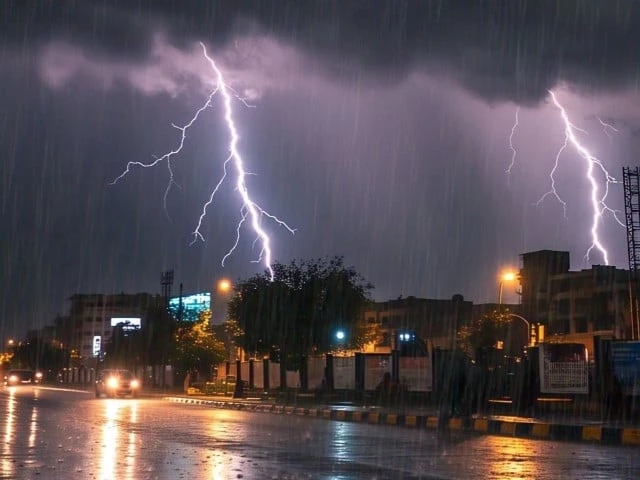
KARACHI: Karachi is expected to experience a shift in weather conditions beginning Monday, as the Pakistan Meteorological Department (PMD) has forecast rain accompanied by winds and thunderstorms.
The rainfall, predicted to continue through Tuesday, is likely to offer much-needed respite to residents of the city who have been enduring intense heat over the past several days.
The PMD stated that light to moderate rain is anticipated in various isolated parts of Karachi. While the showers may not be widespread, they are expected to bring temporary relief from the prevailing hot and humid conditions.
Over the next 24 hours, the weather in Karachi will remain predominantly hot and humid, with skies partly covered by clouds. The maximum temperature is forecasted to rise to 37 degrees Celsius, while humidity levels remain high, currently recorded at 72%. Winds are blowing at a speed of 18 kilometres per hour.
Meteorologists have attributed the current weather pattern to a westerly wave that is affecting the upper and central parts of the country. This system is likely to persist through Sunday and Monday.
As a result, while most regions of Pakistan are expected to remain hot and dry — particularly the plains, where temperatures are forecasted to be very high — there is a likelihood of rain in several areas.
Specifically, partly cloudy weather with dust storms, rain, or thundershowers is expected at isolated locations in North-East and South Punjab, upper Khyber Pakhtunkhwa, upper and South-East Sindh, North-East Balochistan, Azad Jammu and Kashmir, and Gilgit Baltistan.
Some cities have already experienced rainfall, including Gujrat, Mangla, Sialkot, Islamabad, Murree, Mir Khani, Kalam, Dir, Drosh, Rawalakot, and Gupis.
On Saturday, Turbat and Pasni recorded the highest temperatures in the country, with mercury soaring to a scorching 49°C.
In addition to the heat, air quality in Karachi remains a concern. The average Air Quality Index (AQI) was reported at 112, with PM2.5 concentration levels eight times higher than the World Health Organization’s (WHO) recommended annual guideline.
Such pollution levels can pose health risks, particularly for vulnerable groups, including children, the elderly, and those with respiratory conditions.
