


Using the James Webb Space Telescope (JWST), astronomers have observed an intriguing interplay involving a supermassive black hole and two satellite galaxies. This black hole powers a brilliant quasar situated so far away that JWST captures its light as it appeared less than a billion years after the Big Bang. Known as PJ308-21, this quasar resides within an active galactic nucleus (AGN) located in a galaxy currently merging with two sizable satellite galaxies.
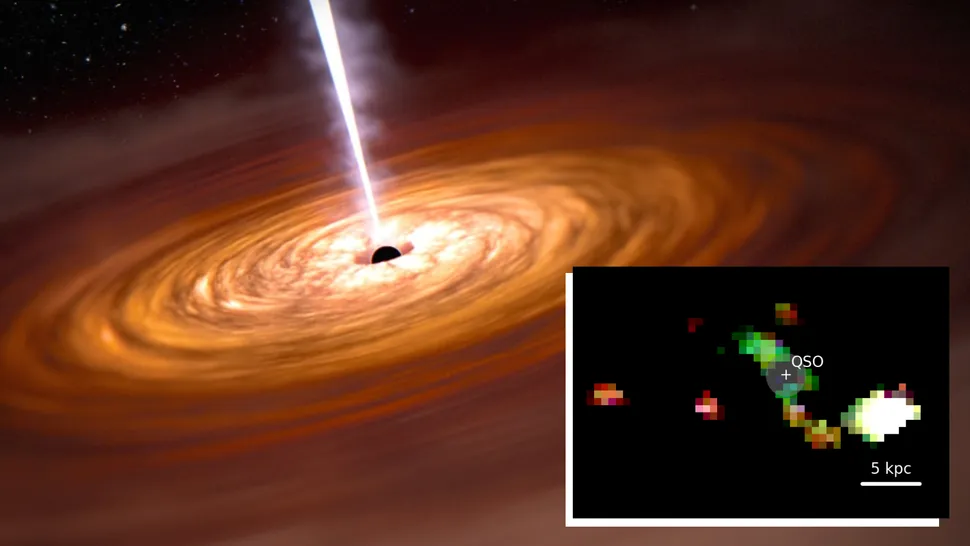
What makes this discovery remarkable is the advanced stage of development of both the quasar and the merging galaxies, considering they existed when the universe was merely a billion years old. The black hole at the heart of the quasar boasts a mass equivalent to two billion suns.
“Our findings suggest that both the black holes at the cores of early, distant quasars and the galaxies hosting them undergo highly efficient and tumultuous growth within the first billion years of cosmic history. This growth is facilitated by the rich galactic environment where these entities formed,” explained Roberto Decarli, lead researcher at Italy’s National Institute for Astrophysics (Inaf).
The data, collected in September 2022 as part of the 1554 Program, utilized JWST’s Near Infrared Spectrograph (NIRSpec). This instrument enabled astronomers to delve into the complexities of this cosmic dance, shedding light on how such massive structures evolve and interact in the early universe.
Decarli’s team’s observations underscore the dynamic nature of early galaxy formation and the pivotal role supermassive black holes play in shaping their environments. This study not only deepens our understanding of cosmic evolution but also highlights the critical insights JWST continues to provide into the origins and growth of galaxies and black holes across cosmic epochs.
