

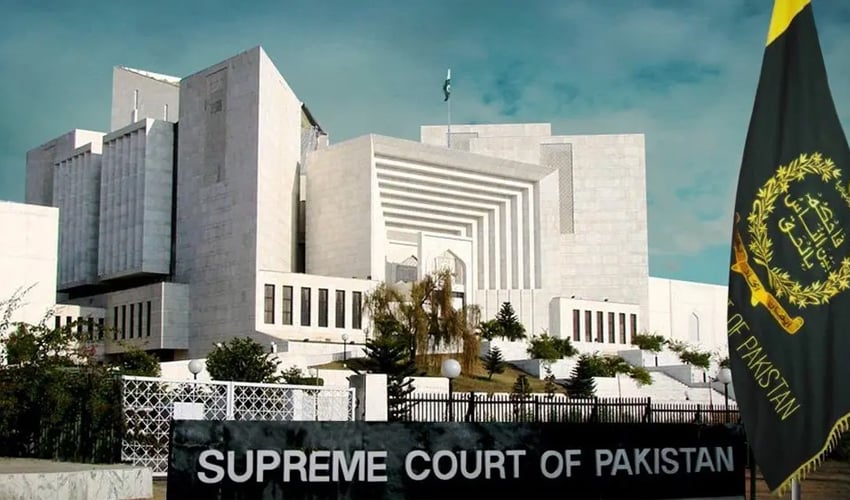

ISLAMABAD: Supreme Court Justice Jamal Khan Mandokhail expressed doubts about the legality of prosecuting civilians under the armed forces’ disciplinary framework. His comments came during a hearing of intra-court appeals against decisions rendered by military courts.
The seven-member constitutional bench, led by Justice Aminuddin Khan, included Justices Muhammad Ali Mazhar, Syed Hasan Azhar Rizvi, Naeem Akhtar Afghan, Musarrat Hilali, Shahid Bilal Hassan, and Mandokhail.
Legal Debate on Military Courts
Senior lawyer Khawaja Haris, representing the federal government, argued that the cases centered on Article 8 of the Constitution, which addresses the enforceability of fundamental rights.
Justice Mandokhail raised fundamental questions, asking, “How can an individual not part of the armed forces fall under its disciplinary code?” He drew an analogy with other departmental codes, stating: “For instance, someone in agriculture is subject to its discipline. How does the armed forces’ discipline apply to a civilian?”
In response, Haris maintained that if the law permits, the military’s disciplinary framework could apply.
Key Questions Raised by the Bench
Justice Musarrat Hilali highlighted the lack of access to FIR copies for individuals held in military custody, while Justice Muhammad Ali Mazhar questioned the reasoning behind an earlier ruling that deemed parts of the Army Act incompatible with Article 8 of the Constitution.
Haris countered by arguing that under specific circumstances, civilians could fall within the scope of the Army Act. He also contended that courts lacked the authority to nullify its provisions.
Justice Mandokhail probed further, asking whether the Army Act undermined Article 8 of the Constitution. He inquired if merely considering incitement could subject a civilian to the Army Act, emphasizing the potential deprivation of fundamental rights.
Hypotheticals and Legal Safeguards
Haris asserted that military trials uphold the right to a fair trial as enshrined in Article 10-A of the Constitution. Justice Mazhar noted that the constitutional bench had the authority to review such points during intra-court appeals.
Justice Mandokhail posed hypotheticals to clarify the scope of the Army Act. For instance, he asked whether an attack on a military installation would fall under military courts’ jurisdiction while an attack on the President’s House would be tried in an anti-terrorism court. Haris replied that such distinctions were made by lawmakers through legislation.
Justice Hilali questioned whether military courts ensured legal representation and access to relevant materials for the accused. Haris affirmed that military trials provided these safeguards.
Core Issue: Applicability to Civilians
The bench’s deliberations repeatedly returned to the core issue: whether civilians could be subject to military law and the implications for their fundamental rights. Justice Mandokhail asked, “How can someone not subject to the Army Act be deprived of their fundamental rights?”
The case remains under review, with the bench continuing to assess the constitutional implications of trying civilians under military courts.
