

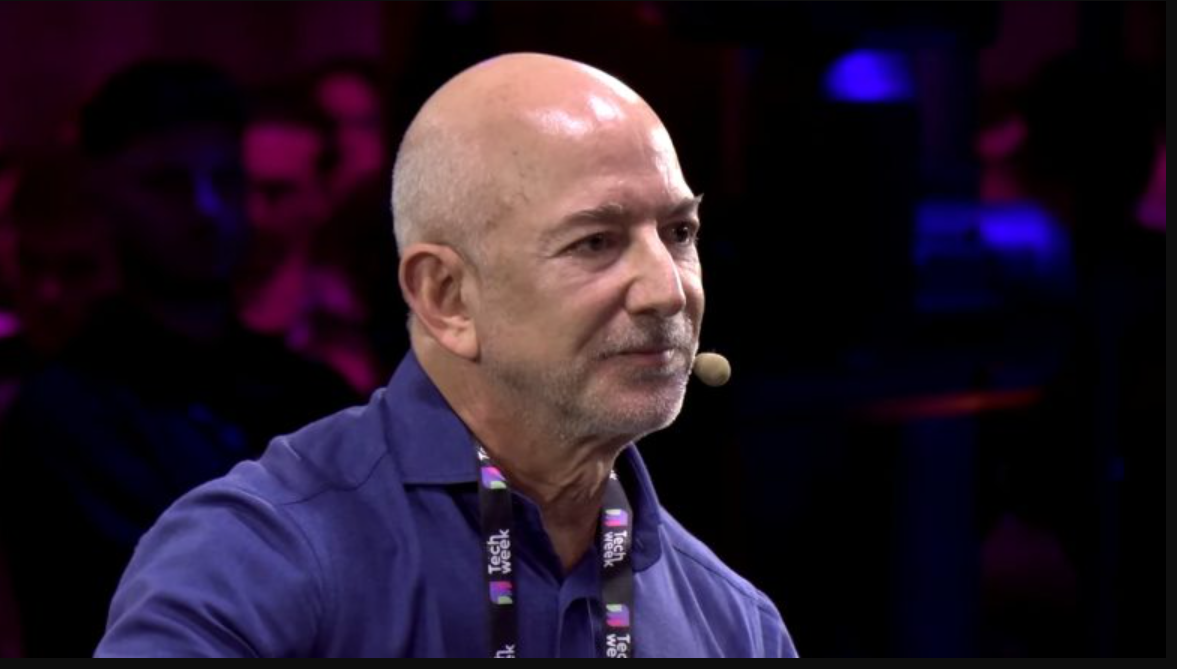

Amazon Founder Shares Bold Vision at Italian Tech Week
Amazon founder Jeff Bezos has predicted that millions of people will live in outer space within the next twenty years. Speaking at Italian Tech Week in Turin, Bezos presented a futuristic vision where humans expand beyond Earth, powered by advanced technologies and artificial intelligence.
Space Habitats Driven by Choice, Not Necessity
According to Bezos, people will choose to live in space rather than being forced by circumstances on Earth. He suggested that large-scale space habitats could emerge as a reality within two decades, supported by advanced robotics and AI systems. Robots, he explained, would carry out most manual labor in space, while massive artificial intelligence data centers would be positioned above Earth to support life and operations.
This perspective highlights a shift in how space colonization is imagined—less about survival on distant planets and more about building functional, human-friendly environments beyond Earth.
Bezos Responds to Elon Musk’s Space Predictions
Bezos’s comments also appeared to respond indirectly to his long-time space industry rival, Elon Musk. Musk has often spoken about colonizing Mars, predicting that one million people could be living there by 2050. In contrast, Bezos envisions human settlements in orbiting habitats rather than on another planet.
While both tech billionaires have ambitious ideas, critics suggest their timelines may be overly optimistic. Nonetheless, the competition between Musk and Bezos has fueled rapid advancements in private space exploration and technological innovation.
Artificial Intelligence Seen as Key to Future Growth
In addition to his space predictions, Bezos defended the surge in artificial intelligence investments. He described the AI boom as an “industrial bubble” rather than a financial one, indicating that the capital flowing into AI research and development will result in significant long-term benefits.
Bezos emphasized that AI, along with robotics, would be central to enabling space settlements and transforming industries on Earth. He expressed strong optimism, stating: “There has never been a better time to be excited about the future.”
Optimism Meets Skepticism
While Bezos’s vision inspired excitement, it also sparked skepticism among some observers. The idea of millions living in space within just two decades raises questions about feasibility, affordability, and global priorities. Critics argue that massive investments will be required not only to create sustainable habitats but also to ensure accessibility for more than just the wealthy.
Nevertheless, Bezos’s statement reflects a broader trend in which space is increasingly viewed as humanity’s next frontier, with powerful private companies leading the charge.
If Bezos’s prediction proves accurate, the coming decades could witness a profound shift in how humans live, work, and interact with technology. From orbital habitats to AI-driven infrastructure, the groundwork for life beyond Earth is slowly being laid.
Whether this bold vision will come to pass remains uncertain, but Bezos insists that technological progress is accelerating at an unprecedented pace. His optimism signals that space colonization is no longer just science fiction, but a potential reality within a single generation.
