

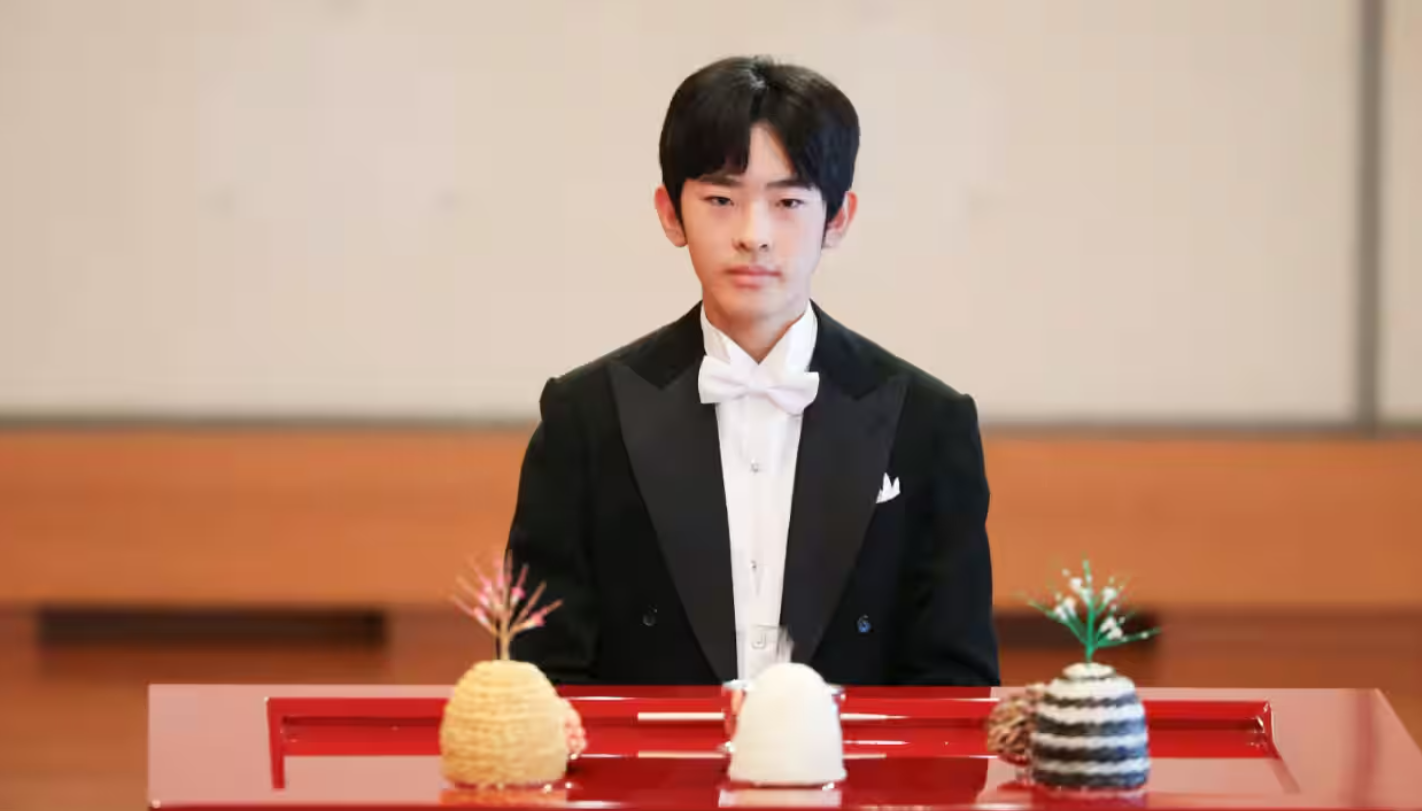

Japan’s Imperial Family recently celebrated a historic moment. Prince Hisahito, the only son of Crown Prince Akishino, has officially entered adulthood. His coming-of-age rituals took place at the Imperial Palace in Tokyo, highlighting his future role as a possible emperor.
The ceremonies were rich with symbolism. Hisahito wore traditional robes and later a black ceremonial headpiece called a “kanmuri.” He received a crown as a formal gesture from Emperor Naruhito, marking his transition into royal responsibility. Afterward, the young prince rode in a horse-drawn carriage to perform prayers at the palace shrines.
The rituals will continue with visits to sacred sites, including the Ise Grand Shrine and the mausoleum of Emperor Jinmu, Japan’s mythical first emperor. These traditions reinforce his position within a monarchy that stretches back 1,500 years.
A Young Royal with Unique Interests
Prince Hisahito, born on September 6, 2006, is the first male royal to reach adulthood in 40 years. He is currently a biology student at Tsukuba University near Tokyo. His academic focus reflects a passion that sets him apart from many royals.
He has a deep fascination with insects, particularly dragonflies. Hisahito even co-authored an academic paper on insect populations within the Akasaka estate, where he lives with his family. In public remarks, he expressed a desire to study urban conservation methods to protect bug populations.
This devotion has earned him the nickname “dragonfly prince,” symbolizing both his youthful curiosity and commitment to environmental study.
Why Hisahito May Be the Last Emperor
Despite the grandeur of his coming-of-age rituals, Japan’s monarchy faces a succession crisis. The Imperial House follows a male-only succession rule, a tradition that limits heirs to the throne. Currently, Prince Hisahito stands as second in line, after his father, Crown Prince Akishino.
However, beyond Hisahito, there are no younger male heirs. Emperor Naruhito has one daughter, Princess Aiko, who is not permitted to ascend the throne under current law. Prince Hitachi, who is next in the line of succession after Akishino and Hisahito, is already 89 years old.
Historians point out that the male-only succession system worked in earlier centuries because emperors had concubines who expanded the royal lineage. That system no longer exists, leaving the dynasty vulnerable. Without reforms, Hisahito may one day be the last emperor of the world’s oldest continuous monarchy.
The Debate Over Female Succession
Japan has a history of female emperors. Eight women have ruled, with the most recent being Empress Gosakuramachi in the 18th century. However, none of them passed the throne to their descendants.
In modern times, debates about allowing female succession have resurfaced. In 2005, the government considered permitting a female emperor. But Hisahito’s birth shifted opinions, and conservative groups opposed the idea.
Experts argue the system must adapt. Proposals include allowing princesses to retain royal status after marriage and giving imperial titles to their children. Some conservative scholars even suggest adopting male descendants from former royal families to preserve the male line.
Still, the debate remains unresolved, leaving the monarchy’s survival tied to Prince Hisahito alone.
A Burden and a Symbol of Hope
Prince Hisahito now carries immense responsibility. Beyond his academic interests and royal duties, he embodies the hopes of those who want the Imperial Family to endure.
During his coming-of-age ceremony, he expressed gratitude to Emperor Naruhito and his parents. He also pledged to fulfill his duties as a royal. His journey reflects both continuity and uncertainty for Japan’s monarchy.
As he steps into adulthood, the nation sees him not only as a future emperor but possibly the last symbol of an institution that has endured for centuries.
