

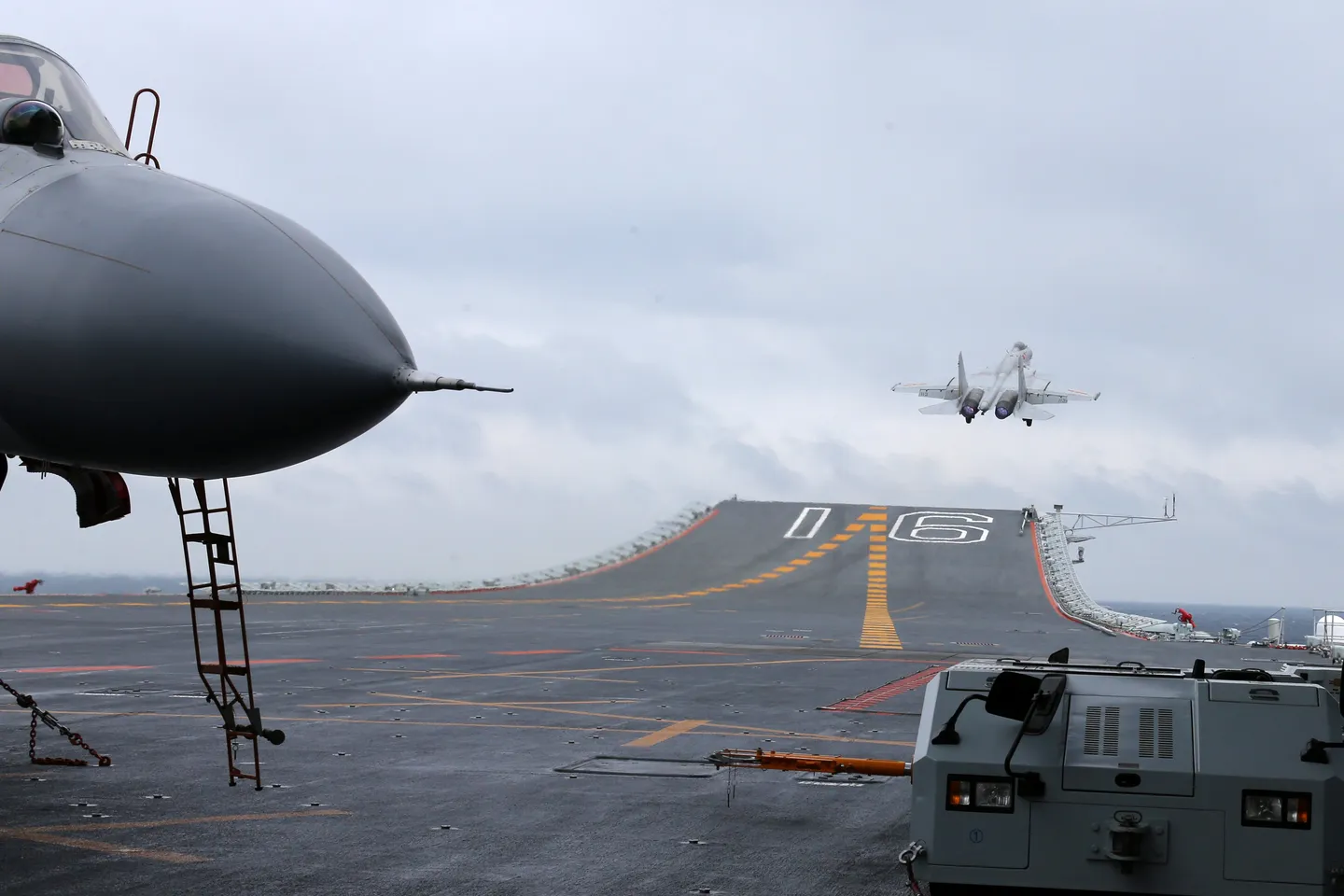

Japan’s defence ministry has accused the Chinese military of engaging in a “dangerous act” after Chinese J-15 fighter jets repeatedly locked their fire-control radar onto Japanese Air Self-Defense Force aircraft southeast of Okinawa. The incidents, reported on Sunday, come at a time of escalating diplomatic friction between Tokyo and Beijing. Relations have deteriorated in recent weeks following comments by Japanese Prime Minister Sanae Takaichi suggesting Japan could provide military support if Taiwan were attacked.
Details of the Radar-Lock Incidents
According to the ministry, the first incident occurred when an F-15 jet scrambled to respond to a Chinese aircraft approaching Japanese airspace. A J-15 launched from the Chinese aircraft carrier Liaoning intermittently locked its radar onto the Japanese jet, a move often viewed as a precursor to missile targeting. Roughly two hours later, another J-15 from the same carrier conducted a similar radar lock on a second Japanese fighter.
Japan stressed that these radar locks exceed what is required for safe aircraft operations and significantly heighten the risk of unintended military escalation. Despite the seriousness of the encounters, no damage or injuries were reported.
Tokyo Issues Strong Protest, Calls for Restraint
Japanese Defence Minister Shinjiro Koizumi denounced the actions as “dangerous and extremely regrettable” during an emergency news conference. He confirmed that Japan had lodged a strong protest with Beijing and demanded steps to prevent further incidents. The ministry’s statement emphasized that fire-control radars are typically used for target identification and weapons guidance, making their use in close-proximity encounters particularly provocative.
Broader Implications for Regional Security
The radar locks reflect deepening security tensions in the East China Sea region, where Japan, China, and Taiwan share overlapping political and territorial concerns. As strategic competition intensifies, such confrontations risk miscalculation, underscoring the need for stronger communication channels and crisis-management mechanisms between the two neighbours.
