

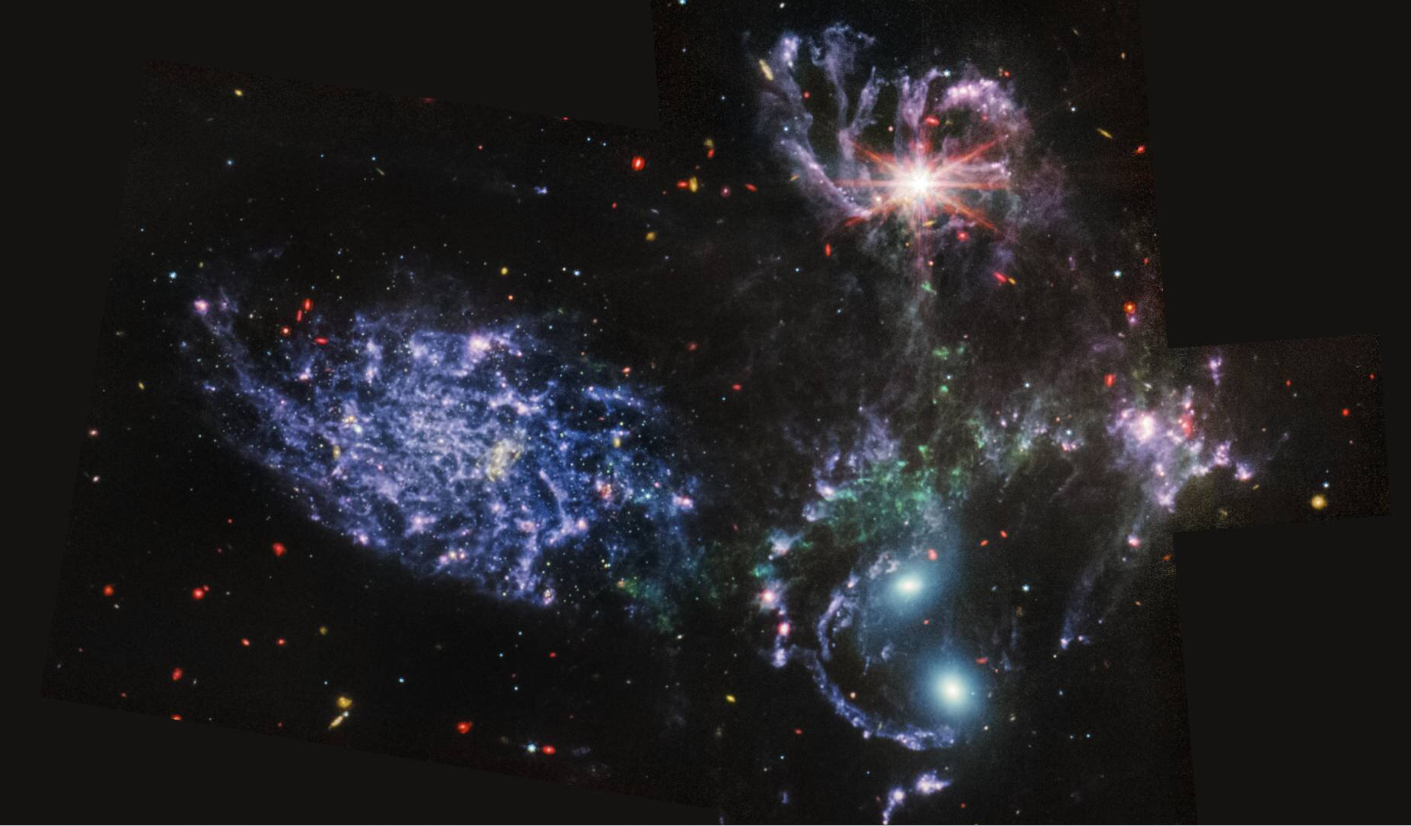

Astronomers have unveiled the most detailed map of dark matter ever created, revealing hidden cosmic structures. Using observations from the James Webb Space Telescope, scientists mapped a sky area nearly three times the size of the full moon. Dark matter dominates the universe, yet it cannot be seen by ordinary telescopes or human eyes. It is detected only through its gravitational influence on galaxies and cosmic structures, shaping the universe on a massive scale.
Ordinary matter, which forms stars, planets, and living beings, accounts for only about 15 percent of all matter. The remaining majority consists of dark matter, which remains invisible because it does not emit or reflect light. Scientists study its effects by observing how gravity bends light from distant galaxies and distorts their shapes, revealing hidden mass along the line of sight.
Tracing Dark Matter Through Gravitational Lensing
The new map relies on gravitational lensing, a phenomenon where massive objects bend light passing near them. This effect causes slight distortions in roughly 250,000 distant galaxies, which Webb captured in unprecedented detail. Earlier maps from the Hubble Space Telescope provided lower resolution, covering smaller areas. Webb’s advanced infrared capabilities now deliver double the resolution, span wider regions, and observe galaxies further back in time.
By peering 8 to 10 billion years into the past, scientists study the crucial era of galaxy formation. Webb’s sharper imaging detects finer dark matter structures and previously unseen concentrations of mass. This enables researchers to construct a much denser grid of background galaxies, improving the accuracy of dark matter mapping.
Revealing the Cosmic Web
The map uncovers the large-scale structure of the universe, known as the cosmic web. Galaxy clusters and massive filaments of dark matter connect galaxies and gas across vast distances. Between these filaments lie less dense regions, forming a complex cosmic network. The observations focus on the Cosmic Evolution Survey area, located toward the constellation Sextans, providing a rich field for future cosmic research.
Understanding the distribution of dark matter is vital because it shapes where galaxies form. Galaxies grow inside dense dark matter halos, which act as gravitational nurseries. Knowing their locations and mass helps scientists model galaxy evolution and explains how the universe transformed from uniform matter to the diverse galaxy population seen today.
Confirming the Standard Cosmological Model
The new findings support the leading Lambda-CDM model of cosmology, which explains the universe’s evolution since the Big Bang. According to this framework, dark matter forms the backbone of cosmic structures, while dark energy drives the universe’s accelerating expansion. The map provides a sharper observational view of dark matter scaffolding, giving researchers stronger evidence for theoretical predictions and refining models of galaxy formation.
A Sharper Future for Cosmic Exploration
The James Webb Space Telescope continues to transform astronomy, enabling scientists to see fainter and more distant galaxies with unmatched precision. Its powerful imaging allows for clearer maps of dark matter, advancing understanding of the universe’s structure. By connecting dark matter distribution to galaxy formation, researchers can explore fundamental questions about cosmic evolution. This latest map marks a major milestone, opening new possibilities for studying the hidden universe and its complex cosmic web.
