

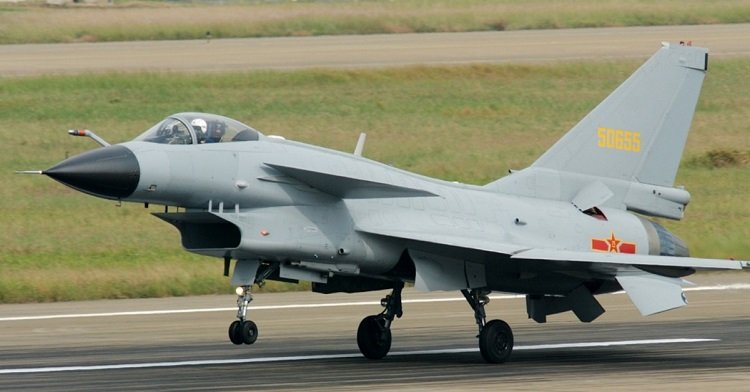

China remained a low-income nation with virtually no industrial infrastructure well into the early 1980s, with nearly 90% of its population living in extreme poverty. Yet this did not deter visionary leader Deng Xiaoping from launching an ambitious project: the development of a domestically built fighter jet capable of countering Western aircraft.
The scale of the project—creating what was dubbed a “new type” of Chinese fighter—was so immense that it extended well beyond Deng’s 11-year tenure. When President Jiang Zemin visited an aircraft production facility in 1994, he famously remarked that the fighter under development would be “more useful than the atom bomb.”
After more than two decades of research, development, and refinement, the result was the J-10—a multi-role fighter designed for air superiority and precision ground attacks. Although it became operational in the mid-2000s, it officially entered combat service in 2018.
On May 7, the J-10C, the most advanced variant of the aircraft, saw its first live combat in what analysts have called the largest air battle since World War II in terms of the number of jets involved.
Pakistan, China’s closest military ally and the only other country operating the J-10C, claims that its Air Force (PAF) shot down five Indian aircraft during the engagement, including three Rafale jets—French-made fighters long considered among the best 4.5-generation warplanes in the world. If confirmed, this would mark the first time Rafales have been downed in combat.
While the Indian Air Force (IAF) has not acknowledged any losses, U.S. and French defense officials have reportedly confirmed the destruction of the Rafale aircraft.
India acquired the Rafales between 2020 and 2022 to serve as the backbone of its aerial combat fleet. Known for their versatility, stealth features, and advanced avionics, Rafales are widely viewed as superior in their class—making their alleged defeat a notable event in modern aerial warfare.
The J-10C’s success in its first combat outing has sparked a fresh debate: has China’s homegrown fighter finally proven itself a credible rival to Western platforms like the Rafale—and at a fraction of the cost?
Military aviation expert Andreas Rupprecht, author of multiple books on Chinese warplanes, says the comparison is premature due to limited data. “It’s the first real sign that Chinese systems are indeed modern. Some in the West—and even in India—might find this surprising: [they’re] not junk or poor copies,” he told TRT World.
Rupprecht added that India may have either overestimated the Rafale or underestimated the capabilities of the J-10C.
Mauro Gilli, a senior researcher in military technology at the Center for Security Studies at the Swiss Federal Institute of Technology, agreed that definitive conclusions can’t yet be drawn. “There is a lot we still don’t know. The downing of the Rafale might have been due to pilot error, flawed mission planning, or other factors,” he said.
What is clear, however, is that May 7 has reshaped perceptions. The battle marked not only the combat debut of the J-10C but also a turning point in global views of Chinese military aviation—once dismissed as inferior, now increasingly seen as formidable.
