


Israeli Airstrikes
TEHRAN: Iran has confirmed that several of its top military commanders and six nuclear scientists were killed in a series of devastating Israeli airstrikes carried out on Friday. The strikes, which targeted key Iranian military and nuclear infrastructure, marked a major escalation in regional tensions and were reportedly aimed at halting Tehran’s progress towards developing a nuclear weapon.
According to Iranian state sources and regional intelligence cited by Reuters, at least 20 senior military commanders, including some of the most powerful figures within Iran’s Revolutionary Guards Corps (IRGC), were killed in the attacks. The targets included nuclear facilities, ballistic missile production sites, and command centers across the country.
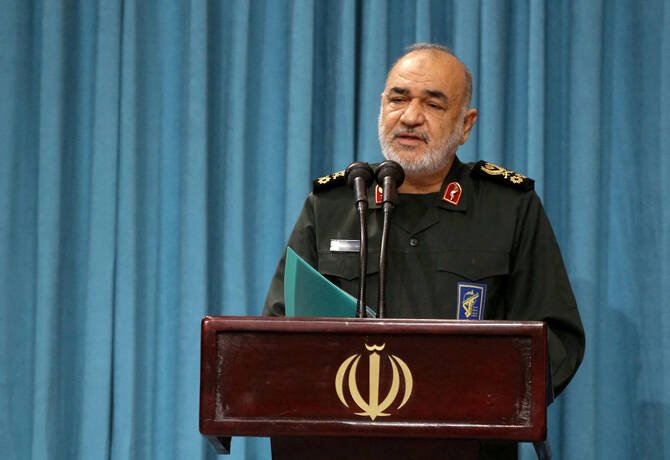
Among the most high-profile casualties was Hossein Salami, the commander-in-chief of the IRGC. Appointed in 2019 by Supreme Leader Ayatollah Ali Khamenei, Salami, born in 1960, was known for his uncompromising stance against Israel and the West. His death represents a significant loss to the core leadership of Iran’s elite military force.
Another major loss was Major General Mohammad Bagheri, the Chief of Staff of Iran’s Armed Forces since 2016. A veteran of the Iran-Iraq war, Bagheri was a former IRGC commander and played a key role in shaping Iran’s defense strategies.
Brigadier General Amir Ali Hajizadeh, head of the IRGC’s Aerospace Force, was also among those killed. Widely regarded as a central figure in Iran’s missile program, Hajizadeh was identified by Israel as the architect behind several aerial attacks on Israeli territory. He had previously come into global focus after taking responsibility for the 2020 downing of a Ukrainian passenger plane during heightened tensions with the United States.
The strikes also killed Major General Gholamali Rashid, the head of the IRGC’s Khatam al Anbia headquarters and former deputy chief of staff of the Iranian Armed Forces. Like several others, Rashid had served in the Iran-Iraq war and remained a key strategist within Iran’s military structure.
In addition to military personnel, six nuclear scientists were killed. Among them was Fereydoun Abbasi-Davani, a former head of Iran’s Atomic Energy Organization and a hardline politician who served in parliament from 2020 to 2024. Another was Mohammad Mehdi Tehranchi, who led the Islamic Azad University in Tehran and played a significant role in Iran’s nuclear academic circles.
The other four scientists who lost their lives were Abdolhamid Manouchehr, Ahmad Reza Zolfaghari, Amirhossein Feghi, and Motalibizadeh. Their contributions to Iran’s scientific and nuclear development programs were considered vital by Iranian authorities.
The attack, which Iran has described as a “flagrant violation of sovereignty,” has drawn international attention and may prompt retaliatory measures. Iran’s leadership has vowed to respond “at a time and place of its choosing,” raising concerns over further escalation in an already volatile region.
