


In the Palestinian Territories, Israel released approximately 150 detainees originating from the Gaza region on Monday, according to Gaza’s crossing authority.
They claimed that these individuals were subjected to mistreatment during their detention. Meanwhile, Israel’s attacks on Gaza persisted, with numerous air strikes occurring throughout the night.
As regional tensions rise due to the possibility of a broader conflict escalation, global powers are urging caution. This comes after Iran launched over 300 drones and missiles at Israel on Saturday.
The most recent detainees who were freed were transported to Israel and exited through the Kerem Shalom border checkpoint. Some of them received medical attention at a hospital in Rafah, situated in the southern part of the embattled region, as reported by the Gaza crossings authority and a correspondent.
Gaza officials assert allegations of mistreatment towards detainees; the United States proposes a fresh truce agreement for both parties to consider.
The spokesperson for the Gaza Crossings Authority, Hisham Adwan, informed about the evident severe mistreatment of prisoners, as some were sent to Abu Yousef al-Najjar Hospital for treatment.
In response, the Israeli military did not address the release of these detainees but stated that mistreatment of those in custody is “absolutely prohibited.” They also mentioned that individuals not involved in terrorist activities are released and returned to the Gaza Strip.
Overnight strikes
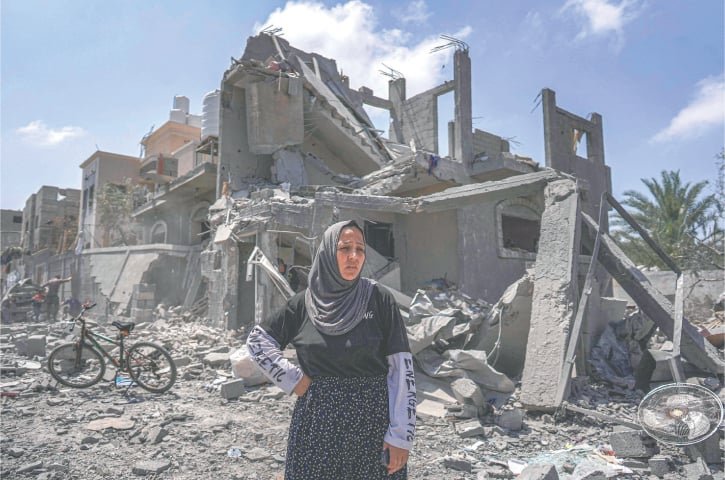
The Hamas government media office reported that Israeli aircraft carried out numerous attacks on central Gaza during the night. As Iran’s unexpected assault raised concerns about a broader conflict, Israel remains focused on the ongoing war.
Rear Admiral Daniel Hagari, an Israeli military spokesperson, emphasized on Sunday that rescuing the captive individuals is their top priority. Approximately 130 people, including 34 believed to be deceased, are still held by Hamas according to Israel since the October 7th attack.
The Israeli army announced the mobilization of approximately two reserve brigades for operations on the Gaza front, a week after withdrawing most ground forces from the area.
Truce deal ‘on the table’
On Saturday late, Hamas announced that it had submitted its response to a truce proposal presented by the US, Qatar, and Egypt during talks initiated in Cairo on April 7th. The group maintained its prior demands, emphasizing on a “permanent ceasefire” and the withdrawal of the Israeli military.
Israel’s Mossad intelligence agency considered this response as a rejection of the proposal, accusing Hamas of exploiting tensions with Iran and aiming for a broader escalation in the region. However, the United States stated that diplomatic efforts were ongoing. The National Security Council’s Kirby mentioned that a new deal was on the table, which would involve the release of hostages, halting combat, and providing more humanitarian aid to Gaza.
As thousands of displaced Palestinians attempted to return to their homes, rumors circulated about an Israeli checkpoint being reopened. Israel denied these claims. A Palestinian man, Mahmoud Awdeh, hoped to reunite with his wife in Khan Yunis, who was waiting at the checkpoint for the army’s approval to proceed north.
Tensions between Israel and Iran’s regional allies have escalated since the Gaza war began after Hamas’s October 7 attack. The UN Security Council convened an emergency meeting on Sunday, during which Israel called for new sanctions against Tehran and UN Secretary-General Antonio Guterres warned that the region was “on the brink” of war.
Iran’s UN envoy, Amir Saeid Iravani, stated that Iran was exercising its right to self-defense in response to the April 1st attack on Tehran’s consular building in Damascus, which has been attributed to Israel.
