

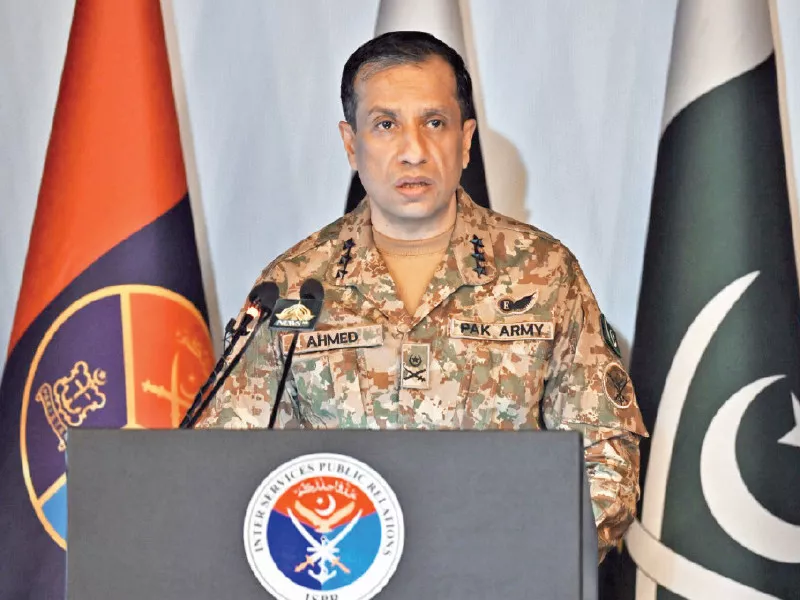

Pakistan’s Director General Inter-Services Public Relations (ISPR), Lt Gen Ahmed Sharif Chaudhry, has strongly dismissed Kabul’s claim that armed terrorists based in Afghanistan are merely “guests”. Addressing senior journalists during an extensive national security briefing, he outlined Pakistan’s security challenges, counterterror operations, border issues, and the country’s position on Afghanistan and India.
Counterterror Operations Intensify Nationwide
According to the DG ISPR, Pakistan has carried out 4,910 intelligence-based operations (IBOs) since November 4, eliminating 206 terrorists. He added that a total of 67,023 IBOs have been conducted across the country this year.
Khyber Pakhtunkhwa recorded 12,857 operations, while Balochistan saw 53,309. In all, 1,873 terrorists — including 136 Afghan nationals — have been killed.
Lt Gen Chaudhry said Pakistan continues to face cross-border threats and criminal networks operating in harsh, mountainous terrain.
Tough Conditions Along the Pak–Afghan Border
The military spokesperson underscored that the Pakistan–Afghanistan border runs through extremely rugged regions. He said global norms require both countries to share responsibility for effective border control.
He accused the Afghan Taliban regime of fully facilitating militants crossing into Pakistan and spreading misleading propaganda about border management.
Key border challenges highlighted include:
-
Non-custom-paid vehicles used in suicide attacks
-
Long gaps of 20–25km between security outposts
-
Fencing that requires both surveillance posts and fire coverage
-
Enormous resources needed for drone deployment and building forts
-
Villages split between both sides of the border
-
Weak or non-existent governance in Afghan border areas
He said a strong “political–terror–crime nexus” exists across the frontier, complicating security operations. Pakistan, he added, has provided Afghanistan with irrefutable evidence of militant presence.
“What kind of guests are these who enter Pakistan armed?” he asked, stressing that Pakistan’s objection is with the Afghan Taliban regime, not with the Afghan people.
The DG ISPR repeated Pakistan’s demand that Kabul end all support to terrorists and agree to a verifiable monitoring mechanism under the Doha Agreement. He warned that Pakistan will deal with armed militants according to its own laws.
Abandoned US Weapons Pose Regional Threat
Lt Gen Chaudhry cited a SIGAR report noting that US forces left behind $7.2 billion worth of equipment in Afghanistan. He said this hardware has empowered terror groups and now threatens multiple countries.
He added that Pakistan’s recent closure of some trade routes is directly related to national security and the safety of its citizens.
Criticism of India’s Military Claims
Turning to India, the DG ISPR criticised Indian military statements as self-deceptive. Responding to remarks linked to the so-called Operation Sindoor, he said:
“If in that trailer seven aircraft are shot down and 26 sites hit, then the full movie would be a horror film for India.”
He said India’s repeated false claims are attempts to manage domestic dissatisfaction.
Anti-Smuggling Drive and Internal Reforms
Lt Gen Chaudhry also outlined major internal security improvements:
-
Iranian diesel smuggling has dropped from 20.5 million litres per day to 2.7 million
-
Funds from smuggled fuel previously supported BLA and BYC activities
-
National Action Plan (NAP) implementation now places 27 Balochistan districts under police control
-
District, divisional and provincial committees are functioning across the province
-
Security forces conduct up to 4,000 community engagements monthly
Without these reforms, he warned, the fight against terrorism cannot succeed.
Foreign-Driven Social Media Campaigns Target Pakistan
The ISPR DG said many anti-state social media accounts on X (Twitter) operate from abroad. He stated that external networks attempt to “inject poison” into Pakistani politics and society.
He said it is clear that much of the online activity targeting Pakistan is orchestrated by foreign-backed groups.
