

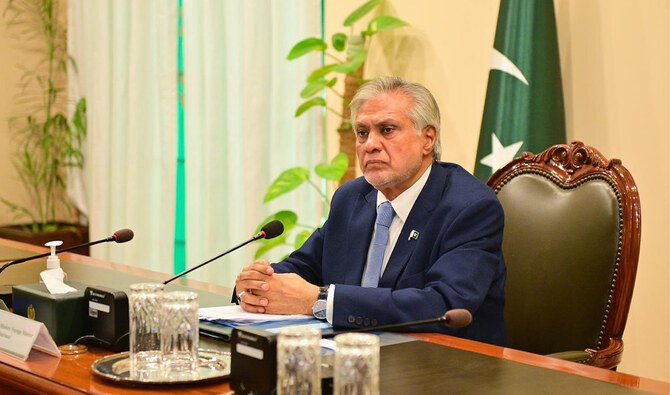

Ishaq Dar
Deputy Prime Minister and Foreign Minister Ishaq Dar has revealed that a phone call from U.S. Secretary of State Marco Rubio played a crucial role in facilitating a ceasefire between India and Pakistan amid heightened regional tensions.
Speaking on the flagship program Rubaroo, Dar disclosed that Rubio informed him that the U.S. had been in contact with Indian officials, who expressed a willingness to agree to a ceasefire, and urged Pakistan to reciprocate.
Dar stated that he immediately conveyed Pakistan’s openness to the proposal, saying the country was “ready with an open heart” to pursue peace. Following this assurance, Rubio again contacted New Delhi, and subsequently confirmed to Islamabad that India had officially agreed to the ceasefire proposal.
The Deputy Prime Minister said the U.S. was particularly concerned about the potential for escalation, especially after President Donald Trump made remarks alluding to the possibility of a nuclear conflict in the region. “We will not be bullied by anyone, nor will we try to bully others,” Dar emphasized, underlining Pakistan’s commitment to peace and regional stability.
He noted that Pakistan’s consistent diplomatic posture helped shift the narrative internationally, increasing pressure on India to de-escalate.
Dar reiterated that Pakistan was not the initiator of hostilities. “We offered investigations. Had we been guilty, we wouldn’t have made such an offer,” he said. He highlighted Pakistan’s transparency and restraint during the crisis, asserting that “the world saw” the responsible conduct of the Pakistani state.
Condemning India’s attempts to assert regional dominance, Dar noted that Western nations had increasingly acknowledged Pakistan’s honest approach. “We don’t need arrogance or empty boasts. Our record speaks for itself,” he said, referencing Pakistan’s heavy toll in the war on terror — over 90,000 lives lost and $150 billion in economic losses. He emphasized that Pakistan remains open to dialogue at any neutral venue, without preconditions.
Meanwhile, Indian media confirmed that New Delhi initiated the ceasefire request. Reports suggested that Foreign Minister S. Jaishankar and NSA Ajit Doval reached out to the U.S. following fears that Pakistan might be preparing its nuclear arsenal.
According to India Today, they also claimed Pakistan was using civilian aircraft to conceal military operations — an allegation that prompted further U.S. involvement.
U.S. media outlets such as CNN reported that American intervention followed a series of significant intelligence warnings, countering earlier Indian narratives that suggested unilateral strength. The developments sparked controversy in India, where many initially believed the U.S. acted at Pakistan’s request. However, once the truth surfaced, public opinion began shifting.
In a dramatic illustration of the media’s changing tone, controversial Indian anchor Arnab Goswami reportedly launched a fierce attack on President Trump during a live show, only to soften his stance after receiving a message during a commercial break.
With mounting criticism at home, the Modi government is now under fire for allegedly seeking a ceasefire out of fear of Pakistan’s nuclear deterrence — a move that contradicts New Delhi’s earlier rhetoric of absolute control and strategic dominance.
