

NEW ROUTING RULES TIGHTEN IRAN’S OVERSIGHT
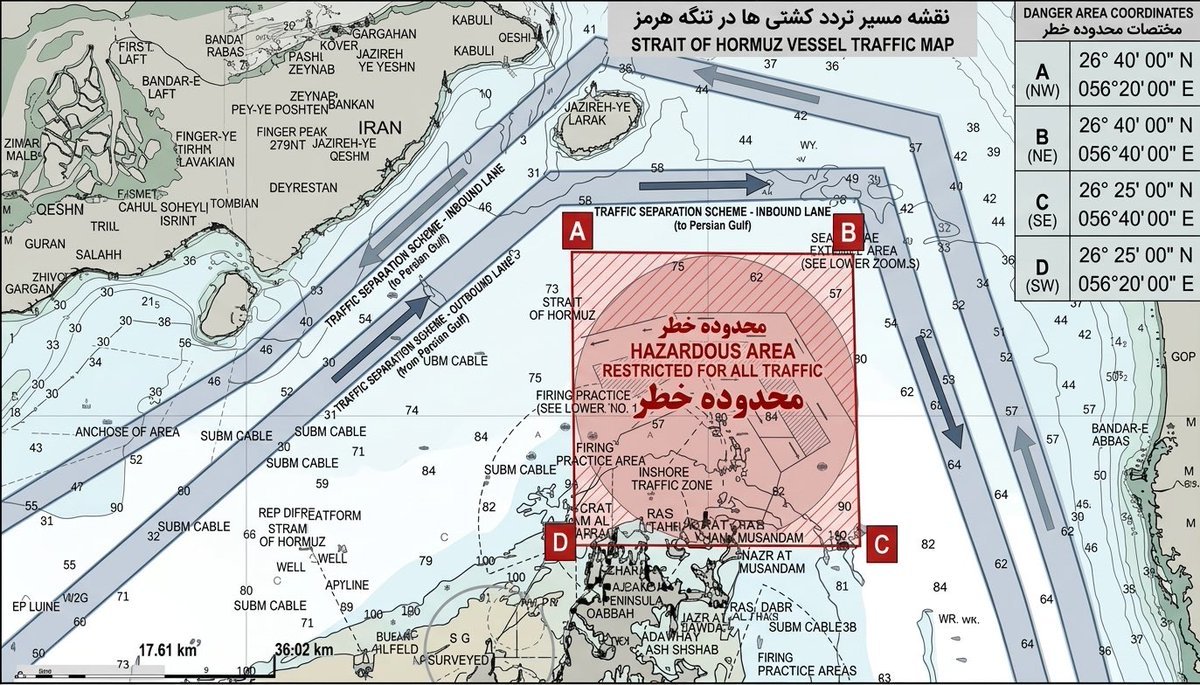
Iran’s Islamic Revolutionary Guard Corps Navy has introduced new restrictions on commercial shipping in the Strait of Hormuz, hours after a ceasefire was expected to restore normal passage. Authorities now require vessels to use two alternative corridors near Larak Island to avoid sea mines laid during recent hostilities.
Under the directive, inbound ships must pass north of Larak Island, while outbound vessels must travel south. Additionally, all ships must coordinate with the IRGC Navy before entering the strait. Officials say the mines, deployed between February and April, remain in standard shipping lanes, forcing traffic into narrower routes enter the Iranian territorial waters.
However, these alternative paths effectively channel vessels through controlled checkpoints. Reports indicate that IRGC patrol boats escort ships individually after verifying clearance codes obtained through prior coordination.
TOLL SYSTEM AND TRAFFIC DELAYS RAISE CONCERNS
Meanwhile, industry sources describe a structured process requiring ship operators to submit detailed documentation, including cargo and ownership data, for screening. Authorities reportedly assign approval tiers and calculate tolls based on cargo, with oil tankers paying roughly one dollar per barrel. Payments are processed in yuan or digital currencies.
As a result, traffic through the strait has slowed significantly. Only 15 to 20 ships reportedly passed within the first 24 hours, compared to a pre-conflict daily average of around 138. Furthermore, hundreds of vessels remain queued outside the strait awaiting clearance.
Gulf states have rejected the toll system, calling it illegal under international maritime law. Similarly, officials in Japan and Oman have stressed that the strait must remain a free and open waterway. Nevertheless, Iran continues to enforce the system, turning away vessels lacking authorization.
Analysts warn the measures could reshape regional trade dynamics if they persist beyond the current ceasefire period.

