

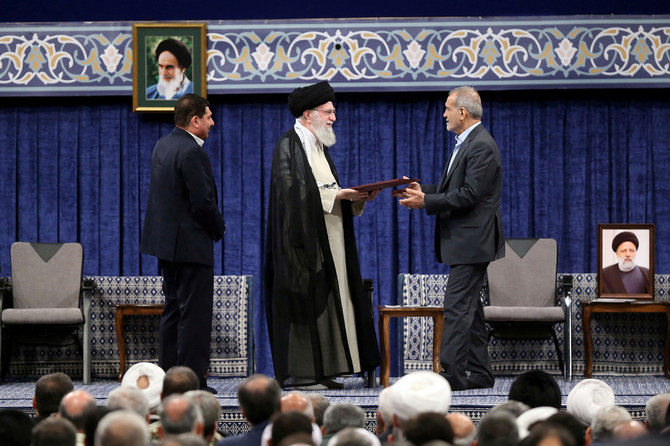

TEHRAN: Iran’s supreme leader Ayatollah Ali Khamenei officially endorsed Masoud Pezeshkian as the Islamic Republic’s ninth president on Sunday, following the reformist camp’s victory in the snap elections.
In a message read by the director of Khamenei’s office, the leader stated: “I endorse the vote (for) the wise, honest, popular and scholarly Mr Pezeshkian, and I am appointing him as the president of the Islamic Republic of Iran.”
Pezeshkian is set to be sworn in before parliament on Tuesday. The endorsement ceremony, held in Tehran, was attended by senior Iranian officials and foreign diplomats and was broadcast on state TV. The ceremony coincided with a nationwide shutdown of banks and most government offices due to an extreme heatwave.
Acting president Mohammad Mokhber handed over official responsibilities to the 69-year-old Pezeshkian. Later, Pezeshkian appointed reformist Mohammad Reza Aref, 72, as his first vice president. Aref has represented Tehran in parliament and served as first vice president and communications minister under Iran’s last reformist president, Mohammad Khatami, who served from 1997 to 2005. Pezeshkian, a heart surgeon and parliament member for Tabriz since 2008, was Khatami’s health minister.
On July 5, Pezeshkian won a runoff race against the ultraconservative Saeed Jalili to replace president Ebrahim Raisi, who died in a helicopter crash in May. Pezeshkian secured over 16 million votes, or about 54 percent of the 30 million ballots cast. Voter turnout in the runoff election was 49.8 percent, an increase from the record low of about 40 percent in the first round, according to Iran’s electoral authority.
Jalili attended Sunday’s ceremony, as did former moderate president Hassan Rouhani, who supported Pezeshkian’s presidential bid along with Iran’s main reformist coalition.
Iran’s president, while influential, is not the head of state; the ultimate authority resides with the supreme leader, a position Khamenei has held for 35 years. Following Khamenei’s endorsement, Pezeshkian thanked the leader and the Iranian people, pledging to shoulder the “heavy burden” of the presidency.
The election occurred amidst heightened regional tensions since the Gaza war began in early October, ongoing disputes with Western powers over Iran’s nuclear program, and domestic discontent over the sanctions-hit economy.
During the ceremony, Khamenei urged the new administration to form an “active and effective” response to regional developments, emphasizing that diplomacy should prioritize neighboring nations. He noted, “We have no intention to oppose some European countries. The reason I didn’t mention European countries as a priority is that they have not treated us well for many years. If they don’t have this bad attitude, then (ties with Europe) would be one of our priorities.”
