

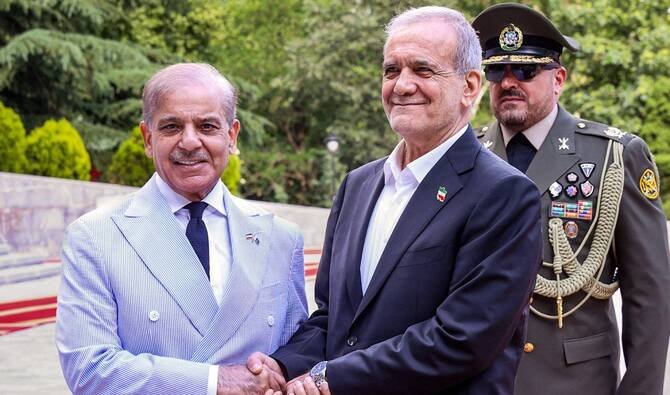

Iranian President Dr Masoud Pezeshkian arrived in Pakistan on Saturday for a two-day official visit, his first since taking office. The visit underscores a renewed push to enhance bilateral cooperation, focusing particularly on trade, border security, and regional connectivity.
Landing in Lahore with a high-level delegation that included Foreign Minister Abbas Araghchi and senior members of the Iranian cabinet, President Pezeshkian received a ceremonial welcome. Welcoming him at the airport were key political figures including a former prime minister and the chief minister of Punjab. The dignitaries exchanged greetings, with floral bouquets presented as a gesture of goodwill.
The Iranian president later visited the mausoleum of Allama Iqbal, where he laid a wreath, offered prayers, and signed the visitors’ book in tribute to the philosopher-poet who envisioned Pakistan’s formation. He was accompanied by the provincial leadership and other senior officials during the solemn visit.
From Lahore, President Pezeshkian travelled to Islamabad, where meetings with President Asif Ali Zardari and Prime Minister Shehbaz Sharif are scheduled. These discussions are expected to address a broad spectrum of topics including bilateral trade expansion, energy cooperation, cross-border management, and the wider regional security environment.
During the visit, Foreign Minister Abbas Araghchi will also hold talks with Pakistan’s Deputy Prime Minister and Foreign Minister, Ishaq Dar. According to diplomatic sources, Tehran is particularly focused on enhancing regional trade by leveraging Pakistan’s strategic position. President Pezeshkian has expressed interest in using the Silk Road as a conduit for deeper economic integration with China. “Through the Silk Road, we can connect with both Pakistan and China,” he stated.
In remarks delivered before departing for Pakistan, the Iranian president emphasized the strong foundation of Pak-Iran relations and expressed ambitions to raise the bilateral trade volume to $10 billion. He described trade ties as robust and saw the Silk Road not only as a link between the three nations—Iran, Pakistan, and China—but also as a potential trade corridor extending to Europe.
The ongoing visit follows several prior diplomatic engagements aimed at deepening cooperation. In April 2024, the previous Iranian president visited Pakistan, resulting in agreements across a variety of sectors including trade, agriculture, culture, health, technology, and the judiciary. Similarly, Pakistan’s Prime Minister last visited Iran in May 2025, underscoring the consistency of high-level exchanges between the two countries.
Officials in both capitals have framed this latest visit as an opportunity to explore new avenues of cooperation and strengthen the long-standing bonds of friendship between the neighbouring nations. The emphasis on strategic trade routes and regional alliances reflects a shared interest in fostering economic growth through connectivity and collaboration.
