

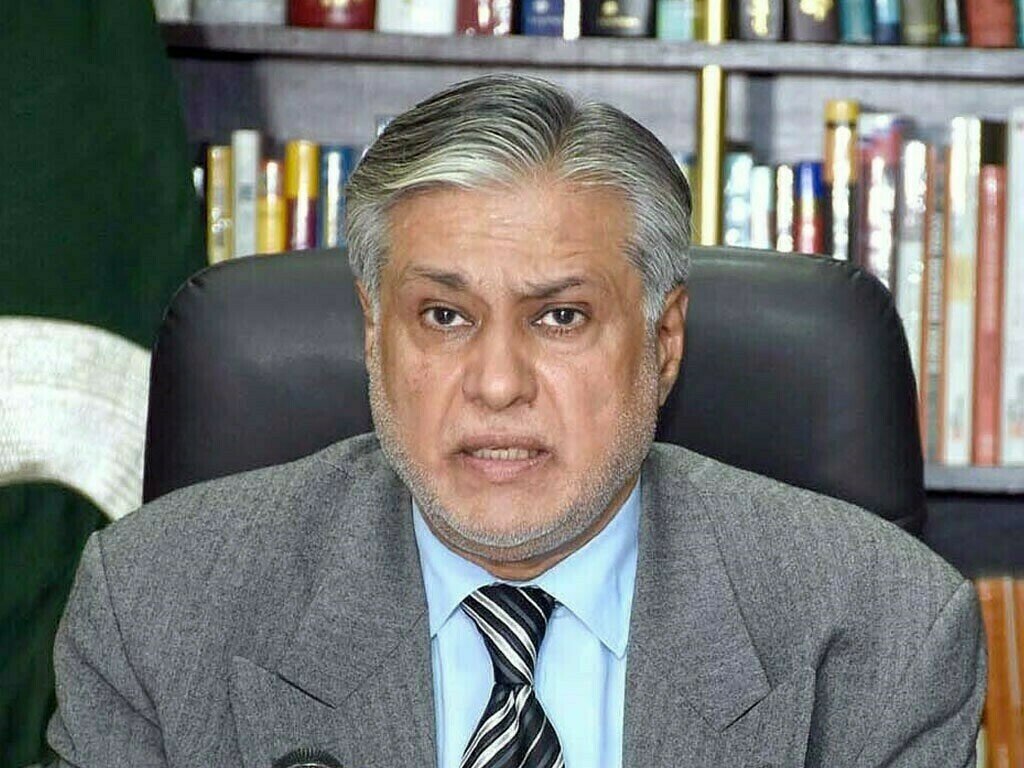

Ishaq Dar
ISLAMABAD: As hostilities between Iran and Israel enter their fourth consecutive day, Pakistan’s Deputy Prime Minister and Foreign Minister Ishaq Dar addressed the Senate on Monday, revealing that Iran is open to returning to diplomatic talks—provided Israel refrains from launching further attacks.
The statement follows a series of deadly strikes between the two adversaries that have left hundreds dead and raised fears of a broader regional escalation.
Dar said he was in direct contact with Iranian Foreign Minister Abbas Araghchi shortly after the first Israeli strikes began. “Iran’s Foreign Minister told me that if Israel does not carry out another attack, they are prepared to return to the negotiating table,” Dar stated on the Senate floor. He added that Pakistan has conveyed Iran’s willingness for talks to other nations, emphasizing that diplomatic channels still have a chance to prevent further bloodshed. “There is still time to stop Israel and bring Iran back to talks,” he urged.
The conflict erupted on Friday when Israel launched a wave of airstrikes across Iran, targeting key military installations, nuclear sites, and civilian areas. According to Iranian authorities, at least 224 people have been killed, including senior military officers, nuclear scientists, and numerous civilians.
In retaliation, Iran launched a series of drone and missile attacks into Israeli territory, killing at least 24 people, according to figures from the Israeli Prime Minister’s Office.
During his Senate speech, Dar underlined Pakistan’s constructive role in promoting peace, saying Islamabad has consistently supported diplomatic engagement between Iran and the United States. “Our intention was always to see successful negotiations between the United States and Iran,” he remarked.
He also noted that Oman and Iran’s foreign ministers remained in regular contact with him throughout the ongoing crisis. “I spoke to Iran’s foreign minister both before and after the Israeli attack,” he revealed, adding that Araghchi had warned of retaliation immediately following the first strike.
In his remarks, Dar strongly condemned the growing wave of misinformation circulating since June 13, describing it as dangerous and destabilizing. “This is not child’s play — a serious conflict is underway,” he warned. “Everyone must act responsibly in such times. We cannot afford to be reckless.”
He referenced the spread of fake news and manipulated media, including a doctored video clip of U.S. President Donald Trump and a misleading circulation of a 2011 interview with Israeli Prime Minister Benjamin Netanyahu portrayed as a recent statement. “Misinformation is being widely circulated — we must exercise caution,” Dar warned.
Addressing alarming rumors on social media about a possible Pakistani nuclear strike, Dar categorically dismissed them as false and irresponsible. “This is completely baseless. We declared in 1998 that our nuclear weapons are solely for our own defence and protection,” he clarified. Pakistan’s nuclear doctrine, he reiterated, is defensive and aimed at maintaining peace and stability in South Asia.
He also pointed out that Pakistan is not a signatory to the Nuclear Non-Proliferation Treaty (NPT) and maintains an independent nuclear stance. He warned that any attack on nuclear installations constitutes a serious crime under international law.
On the issue of Pakistani citizens in Iran, Dar said the Foreign Office had activated a crisis unit to monitor the situation and coordinate efforts for the safety and potential evacuation of nationals.
As the regional crisis deepens, Dar’s remarks reflect Pakistan’s balancing act—urging restraint, denouncing misinformation, and advocating for a return to diplomacy to prevent a wider conflict in the Middle East.
