

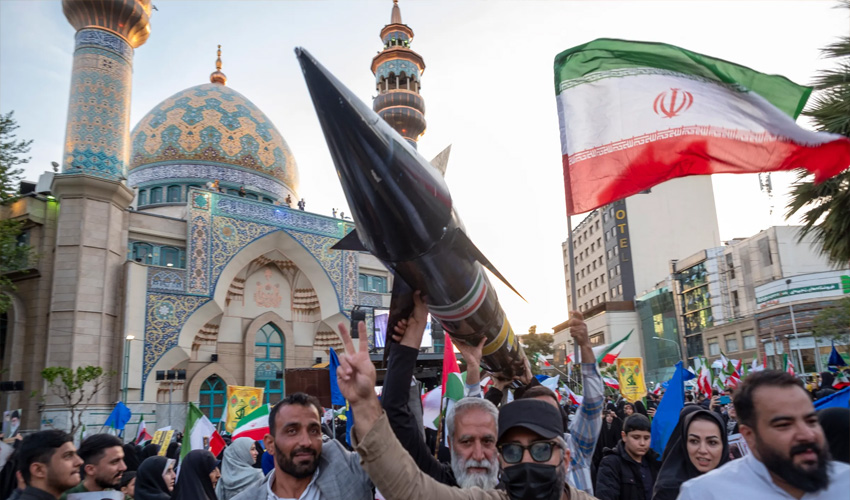

Iran launched around 100 drones toward Israel on Friday in retaliation for a massive wave of Israeli airstrikes that targeted key military and nuclear infrastructure across Iran, killing senior commanders and scientists. The Israeli military said it was actively working to intercept the incoming UAVs.
“Iran launched approximately 100 UAVs toward Israeli territory, which we are working to intercept,” said Israeli military spokesperson Brigadier General Effie Defrin. He also confirmed that Israel deployed 200 fighter jets to hit roughly 100 targets across Iran in what has been dubbed Operation Rising Lion.
The Israeli offensive resulted in the death of IRGC Commander Hossein Salami, and Iranian state media reported that the Islamic Revolutionary Guard Corps headquarters in Tehran was also struck. The attack claimed civilian lives, including children, after residential areas were hit.
“This is a decisive moment in Israel’s history,” Prime Minister Benjamin Netanyahu said in a recorded address. “Operation Rising Lion is a targeted military campaign to eliminate the existential threat posed by Iran. This operation will continue until that threat is removed.”
Iran’s Supreme Leader Ayatollah Ali Khamenei condemned the assault as a “wicked and bloody crime” and warned that Israel would face “a bitter fate.”
Israeli military officials said dozens of critical nuclear and military installations were targeted, including the uranium enrichment facility at Natanz. According to one official, Iran now possesses enough enriched material to construct up to 15 nuclear weapons within days.
While the United States denied involvement in the operation, tensions are escalating rapidly across the region. The U.S. military has raised alert levels and is preparing for potential evacuation scenarios for American civilians, according to a U.S. official.
In addition to the airstrikes, Israel’s Mossad intelligence agency reportedly carried out covert sabotage operations inside Iran, targeting strategic missile sites and air defense infrastructure, Axios reported, citing senior Israeli sources.
Among those killed in the Israeli strikes were nuclear scientists Fereydoon Abbasi and Mohammad Mehdi Tehranchi, both of whom were central figures in Iran’s nuclear research program.
The International Atomic Energy Agency (IAEA) confirmed that Iran reported no increase in radiation levels at the Natanz site. The IAEA also noted that Iran’s only operational nuclear power plant in Bushehr had not been hit.
Back in Israel, Tel Aviv’s Ben Gurion Airport was shut down as the military remained on high alert for Iranian retaliation. Defense Minister Israel Katz said a counterattack was imminent: “Following our pre-emptive strike, we expect a missile and drone assault on Israel’s civilian population.”
Israel’s Chief of Staff Eyal Zamir said tens of thousands of troops had been deployed along the borders. “We are in the midst of a historic campaign to eliminate an existential threat. This is unlike any previous operation,” he said.
Foreign Minister Gideon Saar held back-to-back calls with international counterparts to explain Israel’s position, according to the foreign ministry.
U.S. Distances Itself
U.S. President Donald Trump reiterated that the U.S. had no role in the Israeli strikes and emphasized the importance of diplomacy. “We hope to return to negotiations. But Iran cannot be allowed to develop nuclear weapons,” Trump said in a Fox News interview.
Despite Washington’s denial, Israeli officials told local media that the operation was coordinated with the United States. However, U.S. Secretary of State Marco Rubio insisted the strikes were unilateral and that America’s focus remains on protecting its personnel in the region.
“We are not involved in the strikes,” Rubio said. “But let me be clear: Iran must not target American assets or personnel.”
As both sides brace for further military action, the conflict has plunged the Middle East into a period of acute instability, with fears of a wider war spreading across the region.
