

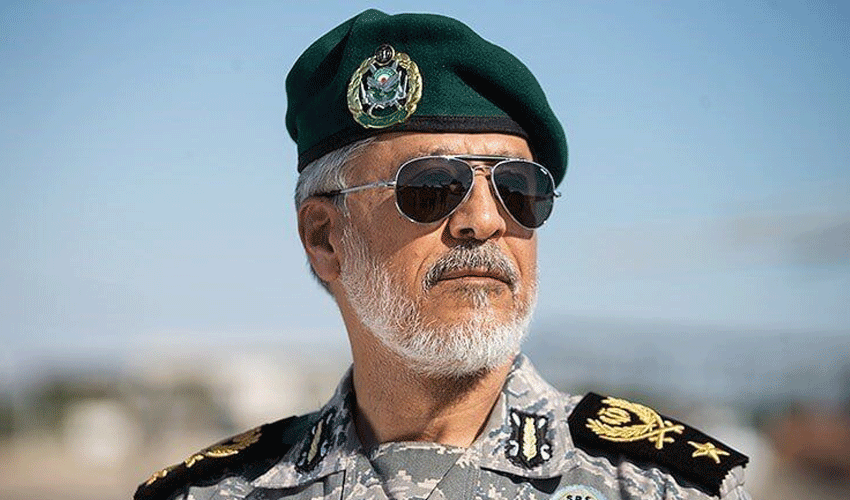

In the aftermath of a devastating Israeli airstrike that killed several top Iranian military leaders, Supreme Leader Ayatollah Ali Khamenei has appointed Rear Admiral Habibollah Sayyari as the interim Chief of Staff of the Iranian Armed Forces. The appointment follows the assassination of General Mohammad Bagheri, Iran’s highest-ranking military officer, in a targeted strike on Tehran.
In a separate move, Major General Ahmad Vahidi has been named the new Commander of the Islamic Revolutionary Guard Corps (IRGC), succeeding the slain IRGC chief, Major General Hossein Salami.
The appointments mark a swift and significant reshuffle at the highest levels of Iran’s military leadership, following what Iranian officials describe as one of the gravest attacks on the country’s defense establishment in recent history.
According to Iran’s semi-official Fars News Agency, General Bagheri was killed early Friday during a wave of Israeli missile strikes that struck multiple locations across the capital, including military installations and residential areas. Bagheri had played a central role in shaping Iran’s military doctrine and coordinating between the regular armed forces and the IRGC.
The same strikes also killed Major General Salami, IRGC Commander-in-Chief, and Major General Gholamali Rashid, head of the Khatam al-Anbia Headquarters, Iran’s principal operational command center. The attack further claimed the lives of two key figures in Iran’s nuclear program — Dr. Mohammad Mahdi Tehranchi, president of Islamic Azad University, and Dr. Fereydoon Abbasi, former head of the Atomic Energy Organization of Iran.
The Israeli strikes triggered immediate fallout. Flights were suspended at Imam Khomeini International Airport due to security concerns, while Iranian media reported numerous civilian casualties as several residential areas were hit alongside military targets.
Iranian Foreign Ministry officials directly blamed the United States, asserting the airstrikes could not have occurred without American coordination or approval. Citing Article 51 of the UN Charter, the ministry vowed that Iran reserves the right to respond and warned of “serious consequences” for both Israel and its allies.
Former U.S. President Donald Trump, in an interview with Fox News, claimed he had been informed in advance of the planned Israeli action but denied any American involvement. He added that U.S. CENTCOM forces remain on high alert and will respond if threatened.
Meanwhile, Saudi Arabia condemned the Israeli operation as a “blatant act of aggression” and a violation of international law, calling on the United Nations Security Council to intervene to prevent a wider regional conflict.
As Tehran installs new leadership and the region braces for potential retaliation, the Israeli strikes appear to have opened a volatile new chapter in the already tense Iran-Israel standoff.
