

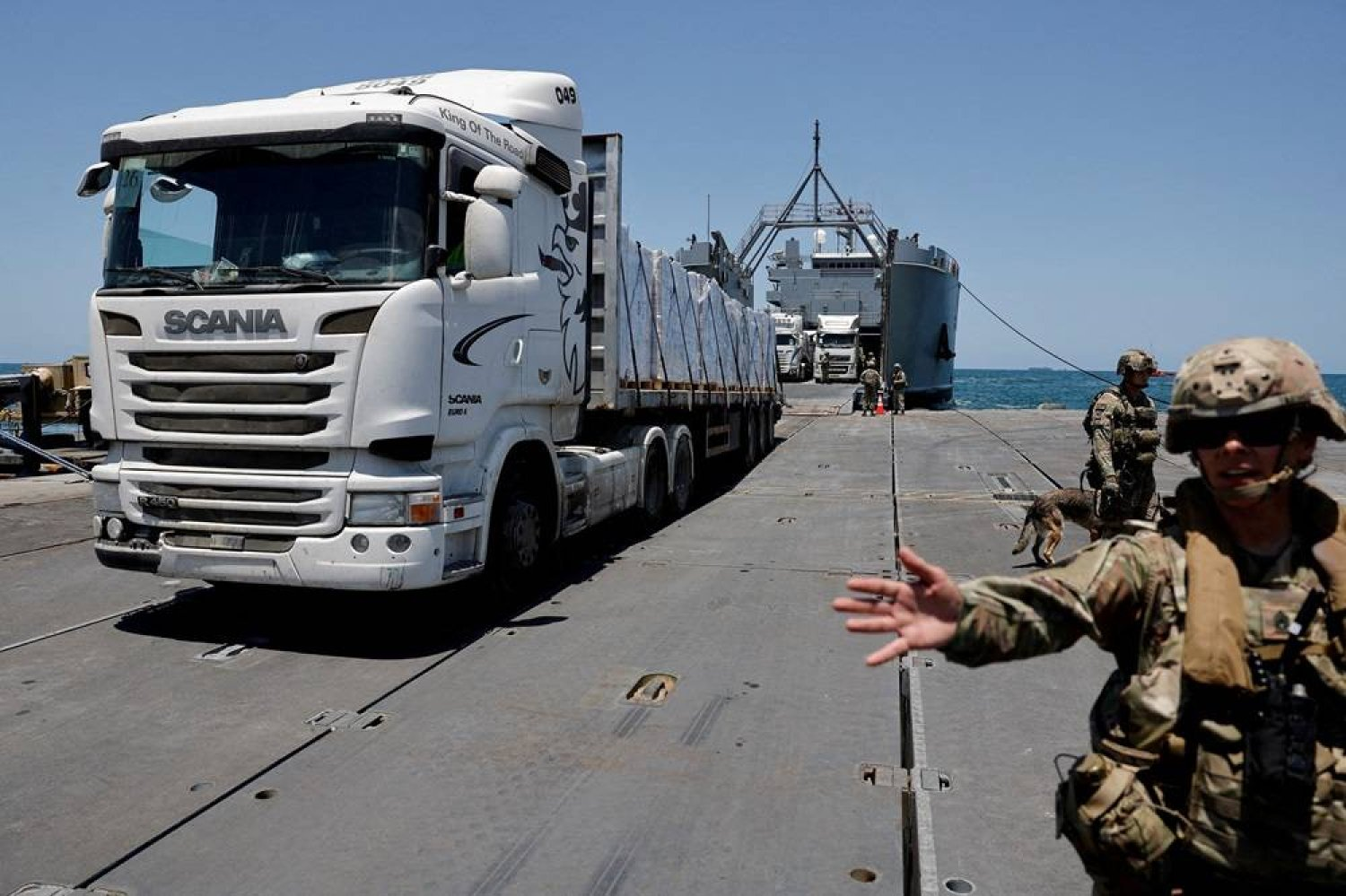

The United States military has announced the conclusion of its mission to install and operate a temporary floating pier off the coast of Gaza, aimed at bringing humanitarian aid to Palestinians. The $230 million pier faced significant challenges due to adverse weather conditions, necessitating its removal and reinstallation multiple times since its initial setup in mid-May.
Despite these issues, US military officials assert that the pier fulfilled its purpose. “Our assessment is that the temporary pier has achieved its intended effect to surge a very high volume of aid into Gaza and ensure that aid reaches the civilians in Gaza in a quick manner,” stated US Navy Vice Admiral Brad Cooper, deputy commander of US Central Command, during a news briefing. He added that the aid mission involving the pier is now complete, with future aid shipments to be routed through Israel’s Port of Ashdod.
However, the pier’s operation has been met with criticism from aid groups and the United Nations, which argued that land routes were more effective for delivering humanitarian aid given Gaza’s severe needs. The UN estimates that 96 percent of Gaza’s population is food insecure, and one in five Palestinians, approximately 495,000 people, face starvation amid Israel’s prolonged conflict with the territory.
Critics have labeled the pier a costly distraction, arguing that the US should have focused on pressuring Israel to allow more aid through Gaza’s land borders. US President Joe Biden, who announced the pier’s construction in March, has expressed disappointment with its performance, acknowledging the repeated operational interruptions as it broke free from the shore.
The project also became a contentious issue in the US Congress, with Republicans criticizing it as a political stunt by Biden. “This chapter might be over in President Biden’s mind, but the national embarrassment that this project has caused is not,” stated Senator Roger Wicker, the top Republican on the Senate Armed Services Committee.
Despite these setbacks, Vice Admiral Cooper praised the nearly 20 million pounds of aid (about 9,000 tonnes) delivered via the pier during its operational days as a “historically unprecedented operation to deliver aid into an active combat zone without any US boots on the ground.” Nonetheless, the distribution of aid once it reaches land has faced significant obstacles due to Gaza’s security situation.
The UN World Food Programme suspended aid deliveries via the pier last month amid an investigation into allegations that the Israeli military used the structure in a rescue operation for four Israeli captives, which resulted in hundreds of civilian Palestinian casualties. As the US military wraps up this troubled mission, the focus now shifts to ensuring that aid continues to reach those in need through more stable and effective channels.
