

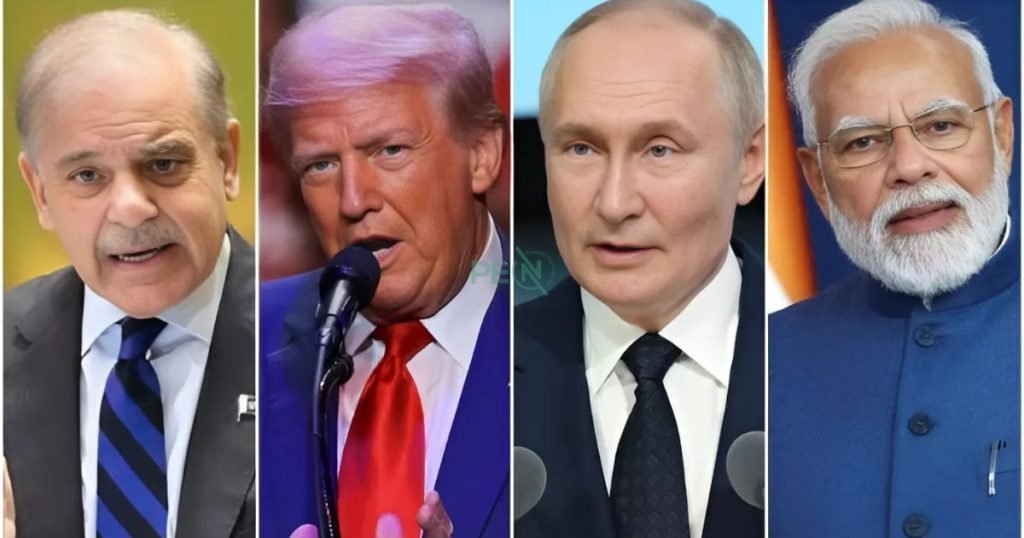

MOSCOW/WASHINGTON – The recent armed conflict between Pakistan and India was a point of discussion during a recent phone call between U.S. President Donald Trump and Russian President Vladimir Putin, the Kremlin confirmed Wednesday. The development underscores the continued international concern over tensions between the two nuclear-armed neighbors.
According to Russian presidential aide Yuri Ushakov, the two leaders spoke for over an hour, discussing several global issues, including the war in Ukraine and the South Asian military confrontation. “The Middle East was discussed, as well as the armed conflict between India and Pakistan, which has been halted with the personal involvement of President Trump,” Ushakov stated.
The brief but intense conflict—triggered by a deadly attack in Indian Illegally Occupied Jammu and Kashmir’s (IIOJK) Pahalgam that killed 26 tourists—led to cross-border strikes and air raids. India accused Pakistan of being behind the incident, a charge Islamabad strongly denied. In retaliation for India’s military actions, Pakistan launched Operation Bunyan-um-Marsoos, reportedly downing six Indian Air Force jets, including three Rafales, along with several drones.
The confrontation lasted nearly four days before Washington brokered a ceasefire on May 10. The successful mediation drew international praise and highlighted the geopolitical stakes of a potential full-scale war between the South Asian rivals.
Pakistan’s Diplomatic Push
In the aftermath, both countries have launched diplomatic initiatives to present their respective narratives on the conflict to the global community.
Pakistan’s diplomatic offensive is being led by former Foreign Minister and Pakistan Peoples Party (PPP) Chairman Bilawal Bhutto Zardari. He is heading a nine-member parliamentary delegation visiting key world capitals. The delegation includes senior figures such as Hina Rabbani Khar, Sherry Rehman, Dr Musadik Malik, Khurram Dastgir Khan, Jalil Abbas Jilani, Tehmina Janjua, Bushra Anjum Butt, and Syed Faisal Subzwari.
Speaking to the Pakistani diaspora in New York, Bilawal warned of the escalating risks of miscalculation in South Asia. “A nuclear conflict in the region would have global consequences,” he said, urging continued international engagement and pressure on India to abandon its aggressive posture and instead pursue a comprehensive dialogue with Pakistan.
Bilawal reaffirmed Pakistan’s position that its military response was in self-defence and reiterated Islamabad’s longstanding call for resolving the Kashmir dispute as a core issue in any future talks.
Call for Investigative Mechanism
In an interview with China’s CCTV News, Bilawal proposed the establishment of a permanent, joint investigative forum between India and Pakistan. Such a neutral platform, he argued, could help both countries investigate terror attacks transparently, including the recent incident in Pahalgam, and prevent further violence.
He emphasized that sustainable peace requires credible mechanisms for justice and accountability on both sides.
Indian Response
From the Indian side, Congress MP Shashi Tharoor, who recently led an all-party delegation to Brazil, indicated a potential opening for dialogue. Tharoor stated that New Delhi would consider talks with Islamabad if there is “demonstrable action against the infrastructure of terrorism visible within Pakistan.”
Despite the political rhetoric, analysts say the path to resumed dialogue remains uncertain, especially amid domestic pressures in both countries. However, the involvement of global powers like the U.S. and Russia highlights the international community’s interest in preventing a future escalation.
