

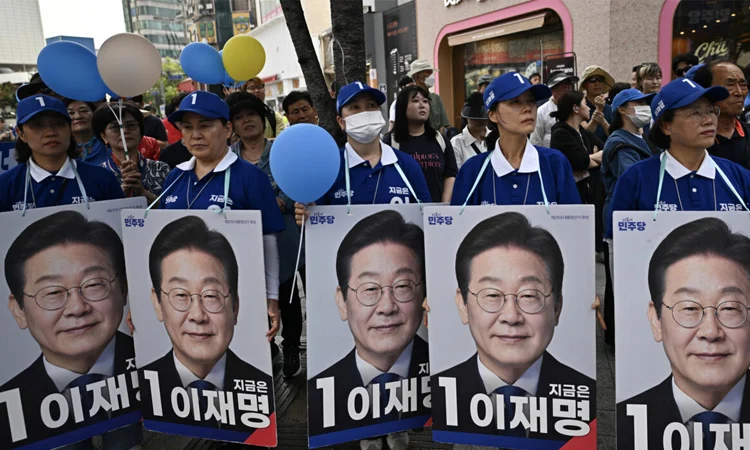

South Koreans headed to the polls on Tuesday to elect a new president, marking the end of six months of political instability triggered by former president Yoon Suk Yeol’s controversial imposition of martial law.
Early in the morning, a few elderly voters gathered at a polling station in Seoul’s Munrae-dong neighborhood to cast their votes as soon as polls opened at 6:00 am.
“We came early, hoping our candidate wins. The presidential election is the most important,” said 80-year-old Yu Bun-dol, who voted for the conservative People Power Party (PPP) candidate.
According to the National Election Commission, millions of citizens had already participated in early voting last week, with over one-third of registered voters casting their ballots during the two-day period.
Polling data consistently showed liberal candidate Lee Jae-myung in the lead, with a recent Gallup Korea survey indicating 49 percent support. His main rival, Kim Moon-soo of the conservative PPP and former party member of impeached president Yoon, trailed at 35 percent.
Experts say the election is largely viewed as a referendum on the previous administration. The fallout from the martial law crisis—during which armed soldiers were deployed to the National Assembly—has left the country without stable leadership during the opening months of U.S. President Donald Trump’s second term.
“The crisis fractured the conservative base and pushed even centrist voters away,” said Kang Joo-hyun, a political science professor at Sookmyung Women’s University.
Analysts also pointed out the deepening crisis within the conservative camp. Yoon’s impeachment made him the second consecutive conservative president removed from office, following Park Geun-hye’s ouster in 2017. Furthermore, conservative candidate Kim Moon-soo failed to reach a unity deal with Lee Jun-seok of the Reform Party, resulting in a divided right-wing vote.
“Conservatives were once seen as steady hands, but recent events have cast doubt on their ability to govern,” said Kang Won-taek, professor at Seoul National University.
With the Democratic Party already holding a parliamentary majority, analysts predict the opposition will remain fragmented unless the conservative bloc regroups.
Unlike regular elections, where a new president takes office following a transition period, the winner of this snap vote will assume office immediately after the National Election Commission confirms the final results.
After months of uncertainty and a rotating roster of interim leaders, many South Koreans are eager for a fresh start.
In Gwangju, a symbolic city for the country’s liberal movement, retired teacher Jung Se-yoon called the election a “turning point.”
“If we miss this opportunity, it may take a long time to rebuild the country,” said Jung.
Voter turnout is expected to be high, with attention now turning to whether Lee Jae-myung can surpass the 50 percent threshold.
“If he secures more than half the votes, it would grant him a strong mandate to lead,” said Bae Kang-hoon, co-founder of the political think tank Valid.
