


Pakistan has strongly criticized India’s alleged efforts to obstruct the flow of water guaranteed under the Indus Waters Treaty (IWT) of 1960, warning the United Nations Security Council (UNSC) of the serious implications of such actions.
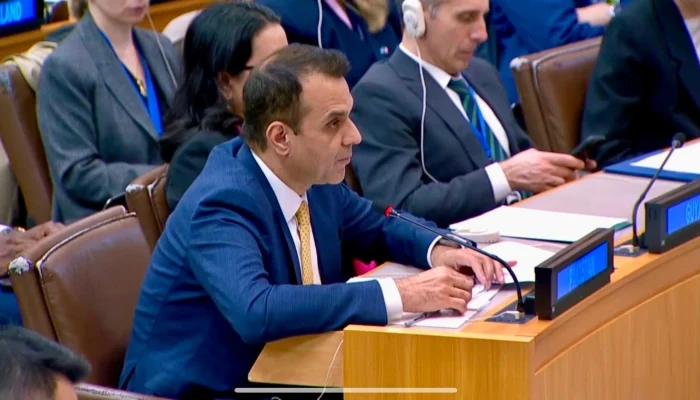
Addressing the UNSC’s Arria Formula meeting on Protecting Water in Armed Conflict, Pakistan’s Deputy Permanent Representative to the UN, Ambassador Usman Jadoon, accused India of attempting to weaponize water by unlawfully suspending its participation in the treaty following an attack in Indian Illegally Occupied Jammu and Kashmir (IIOJK) that New Delhi has blamed on Islamabad.
“These actions represent malevolent designs that violate international law,” Jadoon stated, emphasizing that any attempts to stop, divert, or restrict river flows into Pakistan will not be accepted.
The informal UNSC session, convened by Slovenia in collaboration with Algeria, Panama, Sierra Leone, and the Global Alliance to Spare Water from Armed Conflicts, focused on the protection of water infrastructure during times of conflict.
Opening the debate, Slovenia’s State Secretary Melita Gabric underlined the need to safeguard water supplies and infrastructure, calling such protection an essential element of international humanitarian law.
The Pakistani envoy stressed that attacks on water resources or denial of access to them amount to violations of globally recognized legal norms and human rights. He noted that the UNSC itself has condemned the targeting of essential civilian infrastructure and the unlawful deprivation of resources critical for survival.
Ambassador Jadoon described India’s suspension of the IWT as a blatant breach of international treaty law, human rights law, and customary international law. He also referred to troubling remarks by Indian leaders threatening to “starve the people of Pakistan” as dangerous and provocative.
He urged India to comply fully with its treaty obligations and to cease any actions that may restrict the flow of rivers vital to over 240 million people in Pakistan.
Jadoon concluded by calling on the UNSC to monitor such violations closely and take preventive measures to avoid humanitarian crises. He expressed full support for adherence to international humanitarian and human rights laws, particularly with regard to the protection of water resources and related infrastructure during conflicts.
