

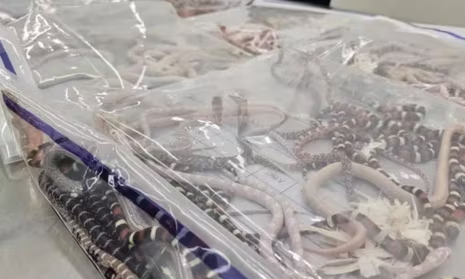

In a bizarre incident, a man attempting to smuggle more than 100 live snakes into mainland China was apprehended by customs authorities, as reported by China Customs on Tuesday.
The unnamed traveler was intercepted by customs officers as he tried to cross from Hong Kong into Shenzhen, China. Upon inspection, officers discovered that the man had stuffed his trousers’ pockets with six canvas drawstring bags, each tightly sealed with tape.
Upon opening these bags, customs officers were stunned to find a variety of live snakes of different shapes, sizes, and colors packed inside. A total of 104 snakes, including milk snakes and corn snakes, many of which were non-native species, were seized.
Accompanying footage released by authorities showed border agents inspecting transparent plastic bags containing squirming red, pink, and white snakes.
China, despite being a major hub for animal trafficking, has significantly intensified efforts to combat illegal wildlife trade under strict biosecurity and disease control laws. Bringing in non-native species without proper authorization is strictly prohibited under these regulations.
The customs authority emphasized that individuals found violating these laws will face legal consequences. However, specific details regarding the punishment for the apprehended smuggler were not disclosed by authorities.
This incident underscores ongoing challenges in wildlife conservation and the rigorous enforcement required to protect biodiversity and prevent the spread of diseases through illegal animal trafficking.
Efforts to curb wildlife trafficking in China have been part of broader international initiatives aimed at conservation and preventing the spread of diseases such as COVID-19, which is believed to have originated from wildlife markets.
The seizure of over 100 live snakes highlights the continued vigilance required to enforce wildlife protection laws effectively. Authorities remain vigilant against such smuggling attempts, underscoring the importance of stringent border controls and public awareness to preserve biodiversity and mitigate risks to public health.
