

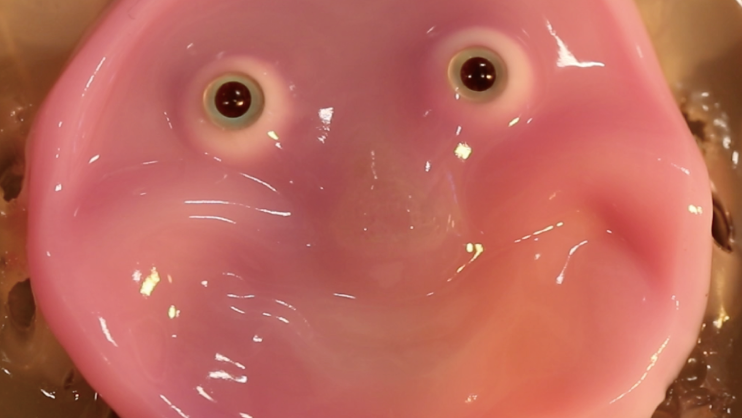

Japanese scientists have achieved breakthroughs with potential implications for cosmetics and medicine by integrating living skin tissue into robotic faces, enabling them to exhibit smiles.
Using ligament-like attachments, researchers from the University of Tokyo cultivated human skin cells in the shape of a face and manipulated them to create a broad grin.
Lead researcher Shoji Takeuchi described the development as a significant step forward in creating robots that are more lifelike. “By attaching these actuators and anchors, it became possible to manipulate living skin for the first time,” he explained.
Over the past decade, Takeuchi and his team have focused on optimizing the integration of biological and artificial components. Their recent study, published online in Cell Reports Physical Science last month, showcased the smiling robot as a result of their efforts.
According to Takeuchi, biological tissue offers advantages over traditional materials like metals and plastics, including energy efficiency in muscles and brains, and the natural healing capability of skin.
Looking ahead, the researchers aim to incorporate nerves and a vascular system into their lab-grown skin. This innovation could lead to safer testing methods for drugs and cosmetics applied to the skin, as well as more realistic robot exteriors.
Despite these advancements, challenges remain in overcoming the unsettling feeling that less realistic robots can evoke. Takeuchi acknowledged this, stating, “I think creating robots with materials and expressions similar to humans may be key to overcoming the uncanny valley.”
