

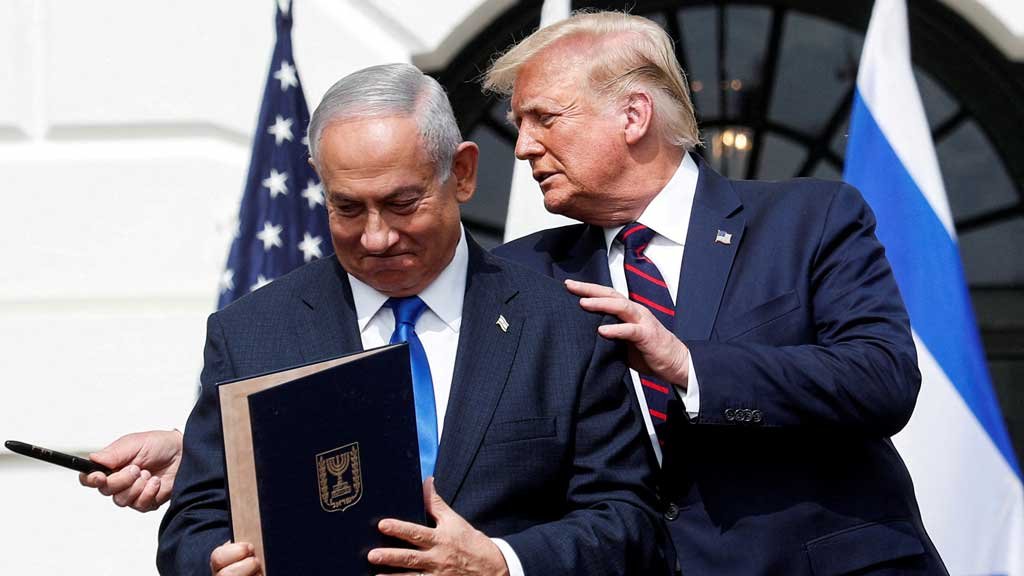

US President Donald Trump has long maintained a clear stance on foreign policy — a strong aversion to dragging the United States into another protracted military conflict. However, Israel’s recent large-scale strikes on Iran have created a serious test for this commitment, potentially placing Trump in a difficult position with his political base.
Despite earlier warnings that an Israeli offensive could trigger a “massive conflict,” Trump ultimately praised the strikes as “excellent.” He emphasized that Israel’s military power, bolstered by American support, was unmatched and hinted that further action could follow unless Tehran agreed to a deal.
This development came just as Trump’s special envoy, Steve Witkoff, was set to engage in a sixth round of talks with Iranian officials in an effort to find a diplomatic solution. Yet, with the military escalation now underway, the future of those talks is uncertain.
While Secretary of State Marco Rubio publicly claimed the United States had no role in the strikes and urged Iran not to retaliate against American troops in the region, a U.S. official confirmed that American forces were assisting Israel in intercepting Iranian missiles launched in response.
According to Alex Vatanka, director of the Iran program at the Middle East Institute, the U.S. aims to maintain a public stance of neutrality while still supporting Israel behind the scenes. The strategy is to avoid overt military entanglement while signaling strength. Iran, he suggested, may opt for caution, weighing the risks of escalating the conflict further.
At present, Tehran’s leadership appears focused on survival. However, the regime could choose between accepting a difficult diplomatic deal or expanding the conflict by destabilizing the Gulf region — a move that could drive up global oil prices and put economic pressure on Washington.
Internal Divisions Within Trump’s Base
While leading Republicans swiftly threw their support behind Israel — a long-standing ally and a central figure in conservative foreign policy circles — the more populist, non-interventionist wing of Trump’s support base remains wary.
Tucker Carlson, a prominent conservative voice who previously urged Trump to avoid direct conflict with Iran, criticized what he views as exaggerated fears about Tehran’s nuclear ambitions. Carlson pointed to a growing divide in Trump’s inner circle — between those pushing for aggressive military responses and those advocating peace.
Trump has appointed several outspoken non-interventionists to key positions. Notably, Director of National Intelligence Tulsi Gabbard recently released a video from Hiroshima, warning that the world risks nuclear disaster due to the influence of “warmongers.”
Just weeks ago in Riyadh, Trump reiterated his vision of America as a peacemaker, criticizing past U.S. military interventions in the Middle East. “I don’t like war,” he declared, reinforcing his promise to avoid unnecessary foreign entanglements.
U.S. Support for Israel Amid Growing Pressure
Daniel Shapiro, former U.S. ambassador to Israel, noted that while American support for Israel’s missile defense was predictable, a much harder decision awaits Trump: whether to commit the U.S. military to targeting Iran’s deeply buried nuclear facilities.
This decision could sharply divide his advisers and political supporters. Critics argue that Israeli Prime Minister Benjamin Netanyahu may be deliberately trying to push the U.S. into a direct conflict — a prospect that many Americans oppose.
Some members of the Democratic Party, already critical of Netanyahu over Israel’s military operations in Gaza, see the latest Israeli strike as a deliberate provocation. “What does ‘America First’ mean if Trump lets Netanyahu drag the U.S. into a war it doesn’t want?” asked Democratic Congressman Joaquin Castro.
Sina Toossi, a fellow at the Center for International Policy, warned that the broader geopolitical implications of the conflict could be severe. With the U.S. increasingly tied to supporting Israel — through military supplies, intelligence sharing, and diplomatic coordination — other global powers might exploit the distraction.
He pointed out that China, identified by Trump as America’s chief strategic rival, could take advantage of the situation, perhaps by making a bold move on Taiwan.
Toossi concluded with a cautionary note: wars are easy to start, but once underway, they tend to spiral out of control, rarely ending on the terms set by those who initiate them.
