

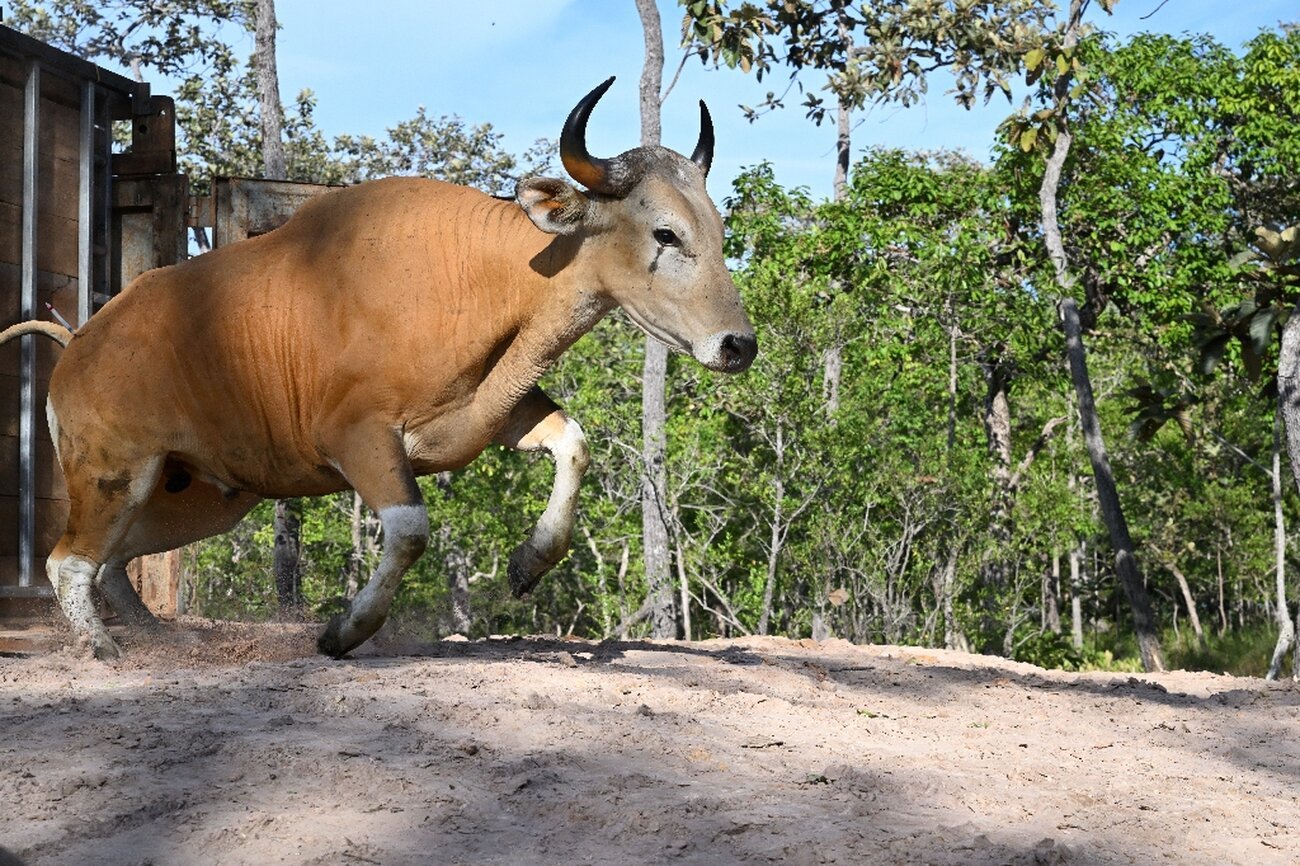

In a groundbreaking conservation effort, 16 critically endangered banteng were successfully herded and relocated in Cambodia using a helicopter for the first time, according to wildlife groups. The operation, conducted by conservation organizations Rising Phoenix and Siem Pang, marks a significant milestone in efforts to protect the rare wild cattle species.
Banteng, native to Southeast Asia, are listed as critically endangered on the International Union for Conservation of Nature’s (IUCN) Red List. Their populations have drastically declined due to hunting, logging, and habitat destruction. These wild cattle thrive in forest and grassland ecosystems, but only a few thousand remain globally.
The relocation took place in northeastern Cambodia’s Siem Pang region, an area that has experienced rapid deforestation. According to Global Forest Watch, Cambodia has lost approximately 33% of its tree cover since 2000, with large-scale land clearances allowed even in protected areas.
From May 13 to 15, 2025, conservationists conducted a three-day operation to guide the banteng into a specially designed “mass-capture funnel trap.” A helicopter played a vital role in directing the animals into the trap—a first in Cambodian conservation history.
Once captured, the banteng were safely loaded onto a truck and transported to the Siem Pang Wildlife Sanctuary, where they will now live under close monitoring and protection.
Rising Phoenix stated that the use of aerial herding techniques “paves the way for similar rescue and relocation operations” for other banteng populations isolated in fragmented forest patches across Cambodia. The new method offers a scalable solution to counter the increasing threat posed by shrinking habitats and poaching.
The relocated banteng are now under the watch of conservation teams at the sanctuary, who aim to ensure their safety and contribute to the revival of their dwindling population.
This operation is being hailed as a hopeful development in the broader battle to conserve Southeast Asia’s rapidly disappearing wildlife.
