

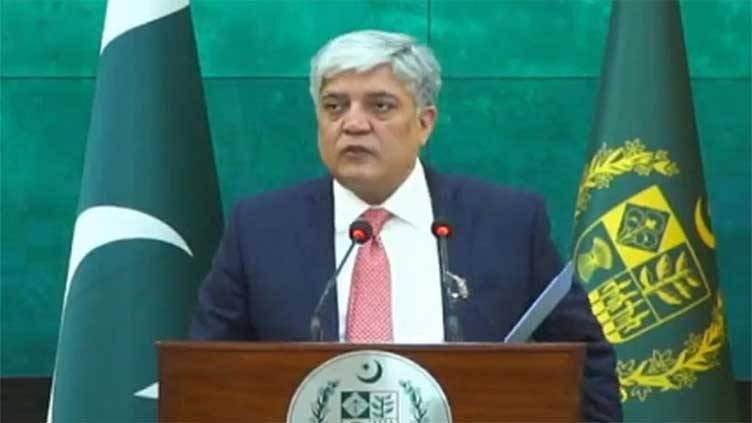

Pakistan’s Foreign Office on Friday rejected the joint statement issued by India and the United States, following a meeting between US President Donald Trump and Indian Prime Minister Narendra Modi, calling it “one-sided, misleading, and contrary to diplomatic norms.”
The statement, released after the leaders met at the White House, accused Pakistan of supporting extremism and referenced the country’s alleged involvement in the 2008 Mumbai attacks. The statement quickly drew a strong response from Pakistan.
During a weekly press briefing, Foreign Office spokesperson Shafqat Ali Khan remarked, “We consider the Pakistan-specific reference in the Indo-US joint statement of February 13 as one-sided, misleading, and contrary to diplomatic norms.”
Khan expressed surprise that the reference was included in the statement despite Pakistan’s ongoing counter-terrorism cooperation with the United States, noting, “Such references cannot obscure India’s sponsorship of terrorism, subversion, and extra-judicial assassinations in the region, nor can they divert attention from India being a safe haven for perpetrators of hate crimes against Muslims and other minorities.”
The spokesperson also emphasized that the joint statement failed to address India’s non-compliance with United Nations Security Council resolutions, a key source of regional instability, nor did it acknowledge the “grim human rights situation” in Jammu and Kashmir.
Khan further criticized the international community’s failure to hold India accountable for these issues, asserting, “Regrettably, this is tantamount to abdication of international responsibility. The international community recognizes Pakistan’s efforts and sacrifices in the fight against terrorism.”
Pakistan, he said, would continue to contribute to regional and global efforts for peace and stability, remaining committed to eradicating terrorism from its soil and addressing cross-border terrorism.
Additionally, Khan voiced concern over the United States’ decision to increase military sales to India, which, according to him, exacerbates military imbalances in the region and undermines strategic stability. He warned that such steps would be unhelpful in achieving lasting peace in South Asia, urging international partners to adopt a more balanced and realistic view of regional peace and security issues.
Trump Announces Extradition of Suspect in 2008 Mumbai Attacks
In a related development, President Trump announced that the United States had approved the extradition of a suspect involved in the 2008 Mumbai attacks, in which over 160 people were killed. Speaking alongside Prime Minister Modi, Trump confirmed that one of the plotters would be sent back to India to face justice.
The attacks, which occurred on November 26, 2008, targeted multiple locations in Mumbai, including hotels, a train station, and a Jewish center. India has accused the Pakistan-based Lashkar-e-Taiba militant group of orchestrating the attacks, though Pakistan has consistently denied any involvement.
While Trump did not name the individual in his statement, the joint statement identified the suspect as Pakistani-origin Chicago businessman and Canadian citizen Tahawwur Rana. Rana was previously sentenced to US federal prison for supporting Lashkar-e-Taiba.
The joint statement also called on Pakistan to “bring to justice those accused of extremist attacks against India and prevent its territory from being used for extremism.”
Pakistan has repeatedly dismissed these accusations, calling them unfounded.
Meanwhile, Trump was also asked about the issue of Sikh separatists in the United States, whom India considers security threats. While Trump did not directly address the question, he emphasized that India and the US collaborate on crime-related matters.
The issue of Sikh separatism has recently strained US-India relations, particularly since 2023, with allegations of India targeting Sikh separatists in the US and Canada. Washington has charged a former Indian intelligence officer in connection with a foiled plot, while India says it is investigating these claims.
