

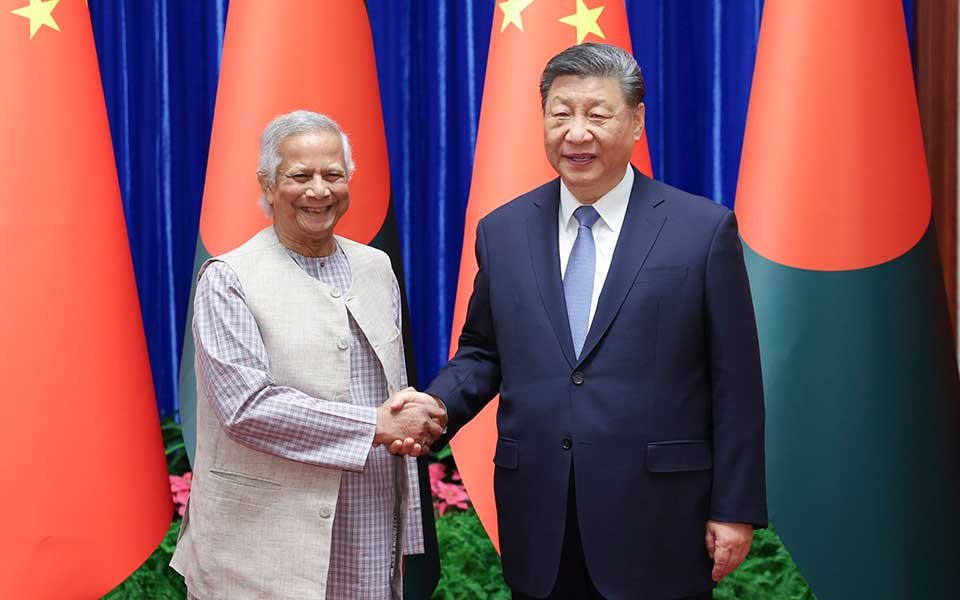

Last year’s mass protests that toppled the Bangladeshi government have reshaped the country’s foreign policy, drawing it closer to China and straining its historically strong ties with India, which remains upset over the fall of its ally, former Prime Minister Sheikh Hasina.
A year after the uprising, tensions risk deepening polarization in Bangladesh ahead of next year’s elections, while also raising fears of foreign interference as political factions compete for influence.
“Relations between India and Bangladesh have perhaps never been under this much strain,” observed Praveen Donthi from the International Crisis Group.
Hasina fled by helicopter to New Delhi in August 2024 as protesters stormed her palace. Her escape angered many in Bangladesh, with interim leader Muhammad Yunus noting that public resentment “shifted towards India” after it offered her refuge. Hasina, 77, has refused to return, defying extradition for crimes against humanity, and has already been convicted in absentia of contempt of court.
Bangladesh’s foreign ministry described the shift in foreign ties as a “readjustment.” Yunus’s first official visit was to Beijing in March, securing $2.1 billion in loans, grants, and investment. China has also directly engaged with Bangladesh’s major political parties, with BNP leader Mirza Fakhrul Islam Alamgir describing Beijing as eager to support the next government.
Meanwhile, Dhaka has moved closer to Pakistan, India’s regional rival, with new trade links and planned direct flights. In May, deadly clashes between Indian and Pakistani forces over Kashmir intensified concerns in New Delhi.
China hosted talks with officials from Dhaka and Islamabad, resulting in new cooperation plans spanning trade, agriculture, and education.
While trade between Bangladesh and India remains significant, diplomatic warmth has faded, replaced by mutual trade restrictions. Former ambassador Md Humayun Kabir urged Bangladesh to balance ties carefully, strengthening multilateral relationships rather than relying on a single partner.
Bangladesh also seeks to ease tensions with the US by proposing increased imports of American wheat, cotton, and oil, alongside plans to purchase Boeing aircraft.
Yet analysts warn regional frictions may persist. “Unless New Delhi feels the next government in Dhaka aligns with its interests, its stance is unlikely to change,” Donthi said. “There may be efforts to weaken rather than engage with the current leadership.”
