

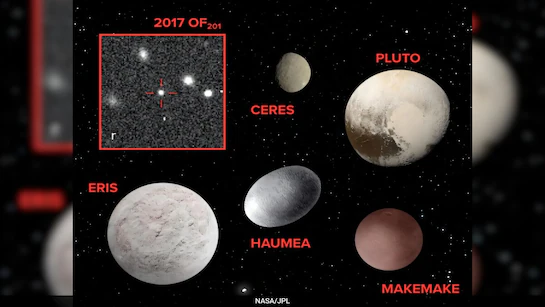

A team of astronomers has identified a new dwarf planet, designated 2017 OF201, located far beyond Neptune in the outer solar system. This discovery, announced in a preprint study last week, adds a significant piece to our understanding of the distant regions of our cosmic neighborhood.
Key Characteristics of 2017 OF201
- Size and Composition: Approximately 700 kilometers (435 miles) in diameter, 2017 OF201 is one of the largest known objects in the outer solar system. Its size and characteristics qualify it as a dwarf planet candidate.
- Orbit: The object follows an extremely elongated orbit with a semi-major axis of 840 AU (astronomical units) and an eccentricity of 0.95. Its perihelion (closest approach to the Sun) is about 44.9 AU, while its aphelion (farthest point) extends to approximately 1,630 AU, placing it within the scattered disc and approaching the inner Oort cloud.
- Observability: Due to its vast distance and elongated orbit, 2017 OF201 is observable from Earth for only about 0.5% of its 25,000-year orbital period, making it a challenging target for detection.
Implications for the Planet Nine Hypothesis
The discovery of 2017 OF201 presents a challenge to the Planet Nine hypothesis, which posits the existence of a large, unseen planet influencing the orbits of distant trans-Neptunian objects. Unlike other objects in the outer solar system that exhibit clustered orbital alignments, 2017 OF201’s orbit is anti-aligned with the proposed Planet Nine orbit, suggesting that its motion may not be influenced by such a massive body.
Future Observations and Research
Astronomers are planning to utilize advanced telescopes, including the James Webb Space Telescope, Hubble Space Telescope, and ALMA, to further study 2017 OF201’s characteristics and its potential role in the solar system’s formation and evolution.
This discovery underscores the dynamic and evolving nature of our understanding of the solar system’s outer reaches and the ongoing efforts to explore its most distant corners.
