

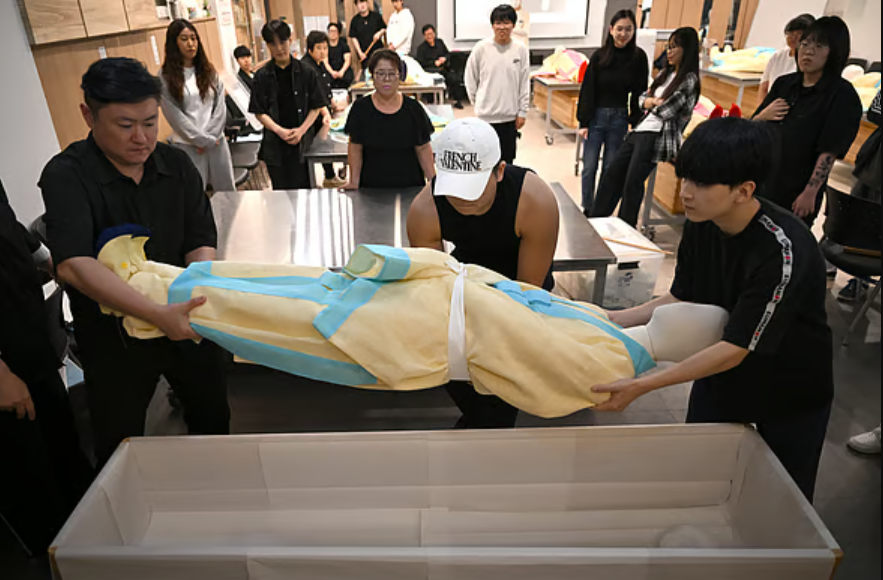

In South Korea’s southern city of Busan, rows of coffins fill a university classroom where students train to become future funeral directors. What was once an overlooked profession is now a growing industry, driven by the country’s rapidly ageing population and rising loneliness among its citizens.
South Korea’s birth rate remains among the lowest in the world, while nearly half its people are aged 50 or older. As a result, more people are finding work in what some call “the business of death.”
Preparing for a Career Surrounded by Farewells
Students at the Busan Institute of Science and Technology are learning every detail of funeral administration — from traditional rites to preparing bodies for burial. During one class, students gently dress mannequins in traditional Korean funeral cloth before laying them into coffins, mimicking real-life rituals.
“For me, it’s about respect,” said 27-year-old student Jang Jin-yeong. “With our society ageing, I know this profession will only become more needed.”
Another trainee, 23-year-old Im Sae-jin, entered the field after losing his grandmother. Witnessing her carefully arranged farewell inspired him to help others during their final goodbyes.
The Growing Reality of Dying Alone
As more people live alone, many also die without family nearby. Single-person households now make up around 42 percent of all homes in South Korea, reflecting a major social shift.
A new and somber profession has emerged as a result — cleaners who specialize in clearing the homes of people who died alone, sometimes months before being discovered.
Former musician Cho Eun-seok, now a professional cleaner, has witnessed hundreds of such cases. “Their homes are like portraits of their lives,” he said. “You can see loneliness in every corner — unopened gifts, empty bottles, and dust-covered memories.”
The Hidden Toll of “Lonely Deaths”
South Korea has the highest suicide rate among developed nations. Many of the “lonely deaths” involve people who took their own lives in isolation. Cho has even been called to clean vehicles where such tragedies occurred.
He is developing a detection device to identify unattended deaths early, as decomposing bodies can lead to infestations and environmental hazards. “In summer, the smell spreads fast. Within three days, it seeps into everything — nothing can be saved,” he said.
One recent case involved an elderly woman who lived alone. Her apartment still held traces of her life — walking sticks by the door, old cosmetics, and a portable toilet — symbols of quiet endurance before her passing.
Finding Humanity in the Aftermath
The work of death cleaners often extends beyond sanitation. Cleaner Kim Seok-jung once discovered unreleased songs written by a late lyricist and turned them into a memorial composition for her grieving family.
Cho recalled visiting a teenage girl who lived alone after fleeing domestic violence. Her tiny room was filled with rotting food and clutter, but she always protected a small box, asking him never to touch it.
A year later, she died by suicide. When Cho returned to clean, he discovered a hamster inside the box — her only companion. “The moment I saw it, I knew I had to save it,” he said softly.
A Younger Generation Faces Death
Even as South Korea confronts its loneliness crisis, more young people are entering the funeral and cleaning sectors. Industry veteran Kim Doo-nyeon said that many new recruits are now in their twenties, drawn by stable employment and a sense of purpose.
“When people live together, some memories remain,” Kim said. “But when someone dies alone, everything must be cleared away.”
Back in Busan, funeral students admit they feel fear about facing death up close. “No matter how much you prepare, it’s still frightening,” said Im, reflecting on his training. Yet for many, the growing demand for such work underscores a deeper truth — in modern South Korea, death has become both a profession and a mirror of isolation.
