

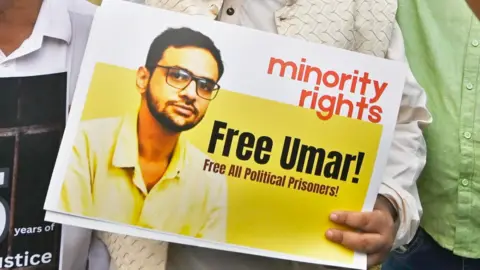

India’s Supreme Court on Monday rejected bail pleas filed by two Muslim student activists, Umar Khalid and Sharjeel Imam, who have spent nearly five years in prison without trial over their alleged role in a conspiracy linked to the 2020 Delhi communal riots.
A bench of the apex court ruled that both men occupied a “central role” in the alleged conspiracy and held that the prolonged delay in the commencement of the trial was not, by itself, sufficient grounds for granting bail. The court, however, allowed bail for five other accused in the same case, observing that their alleged involvement was of a lesser degree.
Khalid and Imam were arrested in 2020 under the Unlawful Activities (Prevention) Act (UAPA), India’s stringent anti-terror law, in connection with violence that erupted in parts of Delhi in February that year. The riots coincided with mass protests against the Citizenship Amendment Act (CAA), a controversial law widely criticised for discriminating against Muslims. At least 53 people were killed in the violence, most of them from the Muslim community.
According to the court, the two activists stood on a “qualitatively different footing” compared to the other accused, citing allegations that they played leadership roles in planning and instigating the unrest. The court relied on submissions by prosecutors who claimed that the violence was part of a larger plot aimed at destabilising the country and harming India’s global image.
Both Khalid and Imam were prominent figures during the nationwide anti-CAA protests and had emerged as vocal critics of Prime Minister Narendra Modi’s government. Their arrests and continued incarceration have drawn sustained criticism from domestic and international human rights organisations, which argue that the UAPA is increasingly being used to suppress dissent.
Under UAPA, accused individuals can be held for extended periods without trial, making bail exceptionally difficult to obtain. Several other cases linked to the Delhi riots have collapsed in recent years after courts found insufficient evidence.
Last week, eight US lawmakers urged Indian authorities to ensure a fair and timely trial for Khalid, while groups such as Amnesty International have repeatedly called for the release of both activists, describing their prolonged detention as a violation of fundamental legal rights.
