

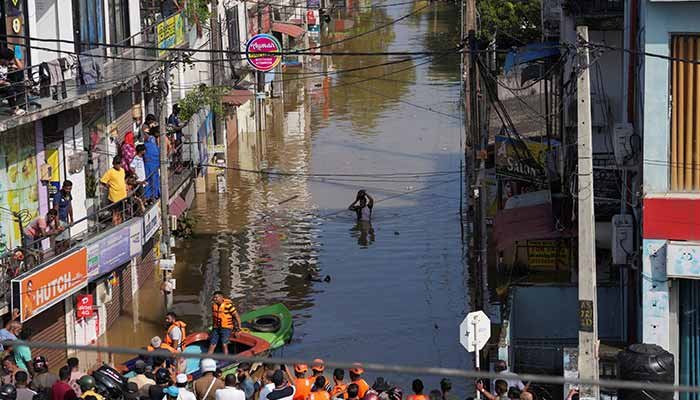

Pakistan’s humanitarian mission to aid cyclone-hit Sri Lanka has been delayed after India denied permission for the use of its airspace, creating a major and unexpected hurdle for the relief effort.
According to Geo News, a 45-member Urban Search and Rescue team from the Pakistan Army, prepared to depart via a C-130 aircraft with support from the National Disaster Management Authority (NDMA) and the Pakistan Air Force, was ready for immediate deployment.
However, the team could not fly after India refused to grant airspace clearance for what Pakistan maintains is a purely humanitarian operation. Plans to send 100 tonnes of relief supplies through commercial cargo aircraft have also been disrupted, as those flights likewise require access to Indian airspace.
With New Delhi’s refusal, Pakistan’s delivery of aid has slowed considerably, forcing authorities to shift to sea transport — a route that will take roughly eight days for the aid to reach Sri Lanka.
Former ambassador Asif Durrani criticised India’s decision, describing it as “petty behaviour.” Speaking to Geo News, he recalled similar actions by India during previous crises, such as when Pakistan attempted to send humanitarian assistance to Nepal. Durrani pointed out that Pakistan, by contrast, had facilitated India’s transport of wheat to Afghanistan via land when its alternative route through Iran proved too costly.
“What more can we, unfortunately, call it?” he remarked, arguing that the latest refusal reflects a narrowly political approach even in situations involving large-scale human suffering.
Cyclone Ditwah, which struck Sri Lanka on Friday, has triggered the country’s worst flooding in a decade, leaving at least 355 people dead and 366 missing. Over half a million people have been affected, with landslides reported across central regions. Rescue teams are working to clear blocked roads, deliver emergency supplies, and reach isolated communities still surrounded by floodwaters.
Weather authorities say the storm is weakening as it moves northwards. Sri Lankan President Anura Kumara Dissanayake described the disaster as the “largest and most challenging” in the nation’s history.
