

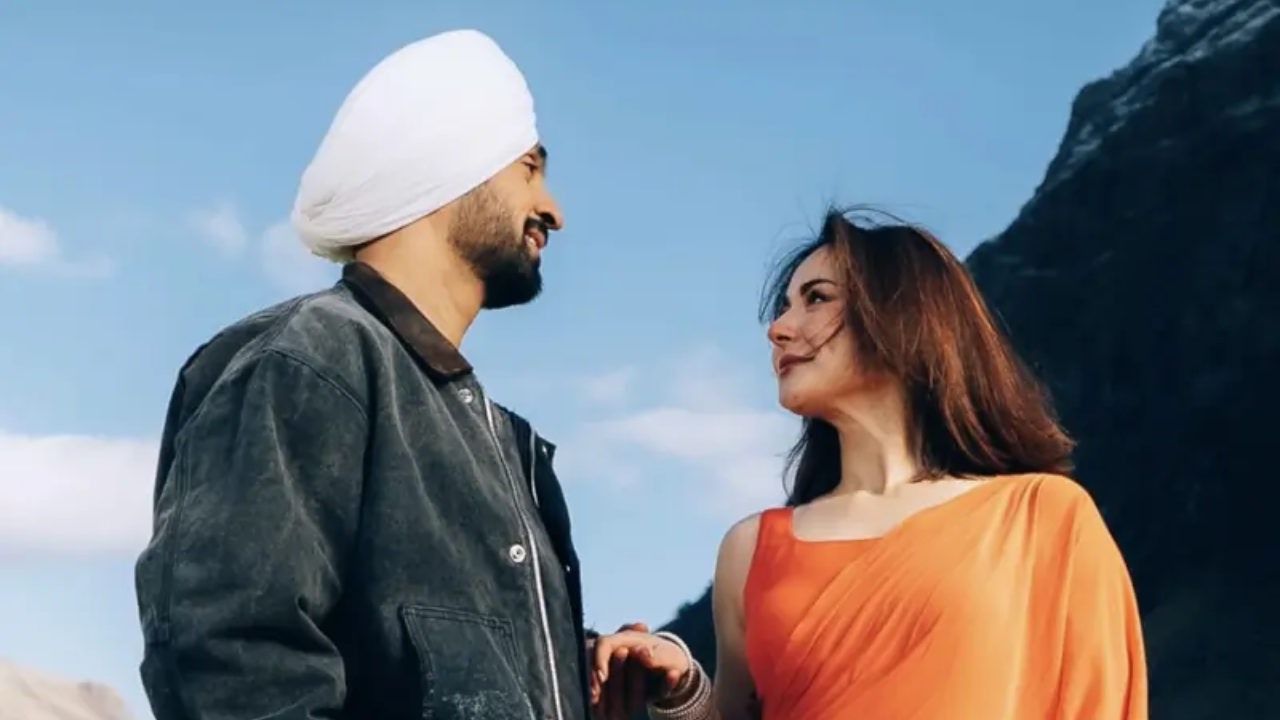

Diljit Dosanjh
Indian film industry organizations have launched a sharp backlash against the upcoming Punjabi-language film Sardaar Ji 3, starring Indian superstar Diljit Dosanjh and Pakistani actress Hania Aamir.
The controversy erupted after two prominent industry bodies — the Federation of Western Indian Cine Employees (FWICE) and the All Indian Cine Workers Association (AICWA) — demanded a full boycott of Dosanjh and the film’s producers for casting a Pakistani actor during a period of heightened India-Pakistan tensions.
Despite the fact that Sardaar Ji 3 is not slated for release in India and is currently targeting only overseas markets, outrage from Indian film bodies has escalated. The film’s producer, Gunbir Singh Sidhu, clarified that shooting for the film concluded before the recent escalation in tensions, particularly following the Pahalgam terror attack in Kashmir.
Indian authorities have blamed Pakistan-based militants for the attack, although Islamabad has firmly denied involvement and asked India to present credible evidence — which it has yet to do.
AICWA issued a fiery statement condemning Diljit Dosanjh for working with Hania Aamir, accusing him of “disrespecting the sentiments of the nation” and “insulting the sacrifices of our brave soldiers.” The statement further claimed that casting a Pakistani actress at a time of national mourning was tantamount to betraying India.
The association labeled Aamir a “terrorist” and accused Dosanjh of prioritizing Pakistani talent over Indian artists. The AICWA has called upon all Indian film bodies, producers, OTT platforms, and music labels to sever professional ties with Dosanjh.
FWICE, another powerful body representing film workers across India, echoed similar sentiments. Its president, BN Tiwari, criticized Dosanjh for repeatedly working with Pakistani artists and announced that all future projects involving him or the producers of Sardaar Ji 3 would be boycotted.
Tiwari emphasized that FWICE would oppose any attempt to release the film in India and urged Prime Minister Narendra Modi to take strict action against the film’s cast and crew, framing the issue as a matter of national integrity.
Adding fuel to the fire, filmmaker and Indian Film & Television Directors’ Association President Ashok Pandit accused Dosanjh of being a “compulsive lawbreaker” who has consistently worked with Pakistani performers despite ongoing tensions.
Speaking to the media, Pandit said Dosanjh has long ignored appeals from the film fraternity to stop collaborating with Pakistani artists, thus undermining the industry’s collective stance on cross-border solidarity during conflicts.
This is not the first time Indian film bodies have clamped down on artists for engaging with Pakistani talent. Previous targets have included Fawad Khan, Atif Aslam, and Mahira Khan.
In each case, the backlash has been immediate, emotionally charged, and nationalistic in tone, often ignoring the artistic intent or cinematic quality of the work in question.
Despite the growing storm in India, there has been an outpouring of support for Hania Aamir in Pakistan. Celebrities like Zara Noor Abbas and Anoushey Ashraf have defended her, arguing that art and culture should not be weaponized in political conflicts. They’ve insisted that artists must be allowed to work freely across borders without being treated as scapegoats.
As for Dosanjh, he has maintained a conspicuous silence on the matter. Instead of engaging with critics, he simply promoted the trailer for Sardaar Ji 3 on his social media accounts this week — unbothered by the criticism swirling around him.
The trailer’s reveal, which confirmed Hania Aamir as the lead, has only intensified calls for sanctions. FWICE has also threatened to lobby India’s Central Board of Film Certification (CBFC) to deny the film certification, even though it is currently not intended for domestic release.
The row underscores a deepening divide between politics and art in South Asia, with actors and filmmakers caught in the middle of broader geopolitical tensions. Whether the film eventually finds its way to Indian cinemas or not, Sardaar Ji 3 has already become a symbol of how cross-border collaborations in art remain fraught — even in times of peace.
