


Indian Army Chief
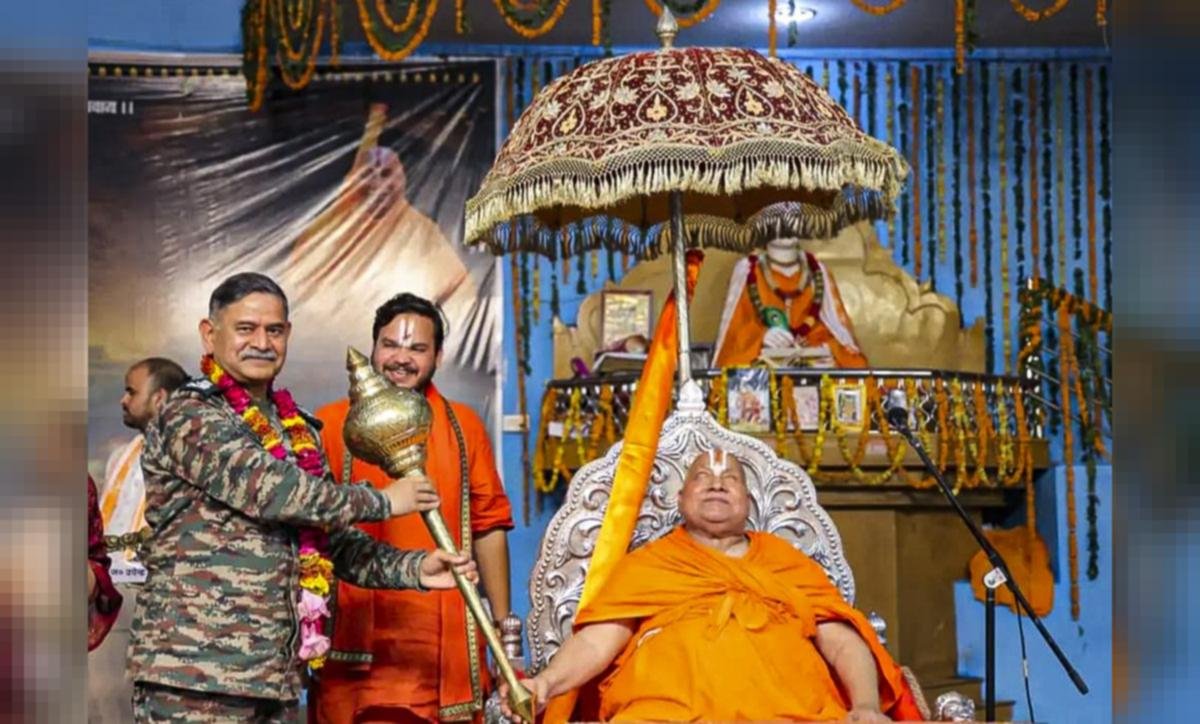
Indian Army Chief General Upendra Dwivedi is facing mounting criticism after his recent visit to a Hindu ashram while in full military uniform. The visit has ignited a broader debate over the secular and apolitical foundations of the Indian armed forces, especially during a time of heightened regional tensions.
General Dwivedi’s visit to the ashram of Hindu spiritual leader Jagadguru Rambhadracharya drew widespread attention after images from the event circulated on social media.
Critics, including prominent journalists and former military officials, have condemned the move as a violation of the longstanding principle of religious neutrality within the Indian military.
Among the most vocal critics was Sushant Singh, a respected Indian journalist and former army officer. In a post on X (formerly Twitter), Singh remarked, “Civil-military relations are strained when military leaders align with partisan religious agendas, undermining the apolitical ethos of India’s secular armed forces.” His comments reflect growing unease over the blurring of lines between military duty and religious expression in India’s defense institutions.
The controversy comes at a particularly sensitive time, as India and Pakistan only recently deescalated a brief yet intense military confrontation. The conflict erupted following a deadly attack on Indian tourists in Pahalgam, located in Indian Illegally Occupied Jammu and Kashmir (IIOJK), which left 26 civilians dead. India promptly blamed Pakistan for the incident, though concrete evidence has yet to be presented.
In response, Pakistan launched “Operation Bunyan-um-Marsoos,” during which it reportedly destroyed multiple Indian military targets and downed six Indian Air Force jets, including three Rafales, alongside dozens of drones. A U.S.-mediated ceasefire on May 10 brought the hostilities to a halt.
While the focus remains on regional stability, General Dwivedi’s actions have reignited scrutiny over the military’s internal code of conduct. The Indian Army has previously emphasized the importance of maintaining religious neutrality.
In fact, a directive issued last year specifically cautioned service members against wearing religious symbols or trinkets while in uniform—following concerns over growing public displays of faith by uniformed officers.
The general’s public association with a religious figure, particularly while in uniform, has raised concerns about the potential politicization of the military. Critics argue that such displays could undermine public trust in the army’s neutrality and professionalism, especially in a country where religion and politics are often deeply intertwined.
As the debate continues, calls are growing for stricter adherence to the military’s apolitical ethos, with demands for clearer boundaries between personal beliefs and official duties.
