

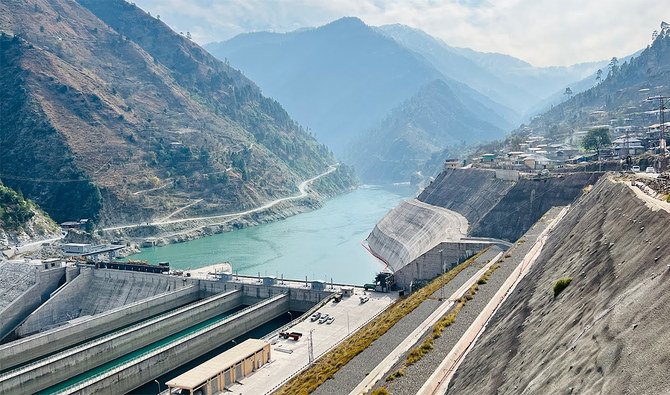

Neelum-Jhelum Dam
Inter-Services Public Relations (ISPR) Director General, Lt Gen Ahmed Sharif Chaudhry, held a media briefing on Wednesday morning, condemning India’s recent actions and providing updates on the latest escalation.
According to Lt Gen Chaudhry, India launched an “unprovoked” attack on Pakistan, which included targeting and damaging the Neelum-Jhelum Hydropower Project.
This attack, he emphasized, was yet another “regrettable act” by India, raising critical questions about international law and the sanctity of water reserves. He asked, “Does international and war law permit the targeting of a nation’s water reserves?”
Lt Gen Chaudhry further elaborated that, in addition to the Neelum-Jhelum Dam attack, India’s aggression on the night between May 6 and 7 extended to multiple locations in Pakistan. Six areas were targeted, including mosques and civilian regions.
The deadly strike resulted in the martyrdom of at least 26 Pakistani civilians, while 46 others sustained injuries. India’s actions have drawn widespread condemnation, particularly for deliberately attacking places of worship, with mosques in Ahmedpur East and Muridke hit by Indian forces.
In Ahmedpur East, a mosque was bombed, injuring 37 individuals, including nine women and three girls. In another mosque, Masjid Abbas, a 16-year-old girl and an 18-year-old boy were killed, while a mother and daughter were wounded.
The attacks also affected Muridke, where three men were martyred, and one other person was injured. Despite these horrific losses, Lt Gen Chaudhry noted that areas like Sialkot and Shakargarh, while targeted, thankfully did not suffer casualties or significant damage.
The ISPR chief pointed out that these same areas were visited by both local and foreign media on Tuesday and found no military installations or significant infrastructure. This, he suggested, contradicted the narrative being pushed by Indian propaganda.
The Pakistani military’s swift response included shooting down five Indian fighter jets, including three Rafale jets and one MiG-29, in airspace over Bathinda, Jammu, and Srinagar. Pakistan’s Air Force acted quickly, ensuring that no Indian aircraft breached Pakistani airspace.
Furthermore, the Pakistan Army targeted and destroyed key Indian military positions, including an Infantry Brigade Headquarters and several enemy checkpoints in various sectors. In a notable encounter, 50 Indian soldiers fled from a post in the Badori sector during Pakistan’s counterstrike. Lt Gen Chaudhry reassured the public that Pakistan’s military assets remained secure, and the armed forces gave a “befitting response” to the aggression.
He also highlighted the upcoming scheduled visits by both domestic and international media to Muridke and Bahawalpur, emphasizing transparency and countering India’s propagandist claims. These areas, now targeted by India, had been visited just a day prior by the press, providing further evidence of the provocative nature of the Indian assault.
Pakistan has condemned India’s actions as a serious violation of the ceasefire along the Line of Control, marking a dangerous escalation in tensions. The ISPR spokesperson reiterated that while Pakistan does not seek war, it is fully prepared to defend itself against any further aggression.
The Pakistani government has vowed to raise this issue on every relevant international platform to ensure global awareness of India’s provocative behavior.
