

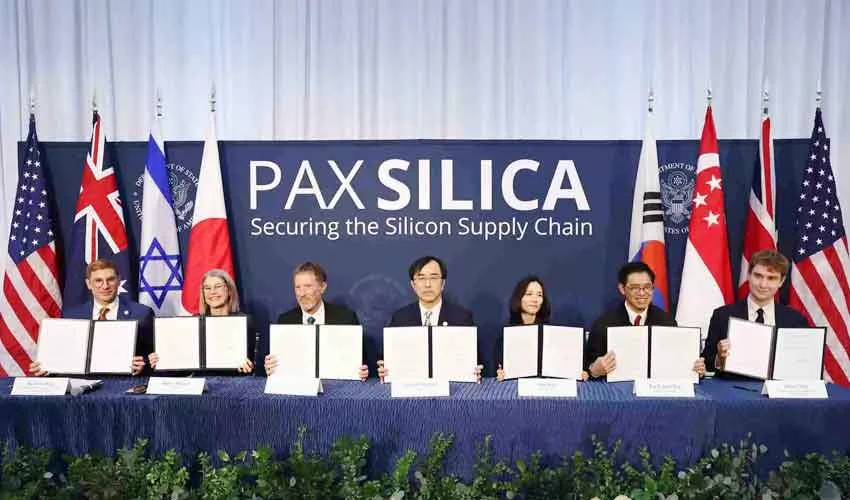

India has faced a diplomatic setback after being excluded from the US-led advanced technology alliance, Pax Silica, highlighting concerns over the Modi government’s global standing.
The initiative, aimed at building a secure and resilient global silicon and critical minerals supply chain, focuses on semiconductors, AI infrastructure, and advanced manufacturing while reducing reliance on China-dominated networks.
Despite ongoing trade and technology discussions with Washington, India was not invited to the first Pax Silica summit. Countries included are Japan, South Korea, Singapore, the Netherlands, the United Kingdom, Israel, the United Arab Emirates, and Australia—nations hosting leading companies and investors in AI and semiconductor industries. India’s absence raises questions about its role in the global advanced technology ecosystem.
Opposition leaders have linked India’s exclusion to recent geopolitical and military setbacks, notably the defeat against Pakistan in May. Senior Congress leader Jairam Ramesh described it as a “key reason” for India’s diminishing global influence.
Critics argue that despite close personal ties between Prime Minister Narendra Modi and US leaders, India has failed to secure a seat in this strategically crucial alliance, exposing limitations in its diplomatic outreach.
This development contrasts with recent India-US cooperation, such as the 2024 MoU on critical minerals and the Initiative on Critical and Emerging Technologies (iCET), which were intended to strengthen technological and clean energy collaboration.
Analysts say India’s omission from Pax Silica suggests that New Delhi is not yet considered a full-spectrum partner in cutting-edge AI, semiconductor, and advanced manufacturing supply chains.
As of now, there has been no official response from Indian authorities, intensifying political criticism and debate over India’s foreign policy direction. Observers note that while India remains a key regional player, its exclusion from high-level global technology forums underscores challenges in achieving full strategic parity with leading technological powers.
