

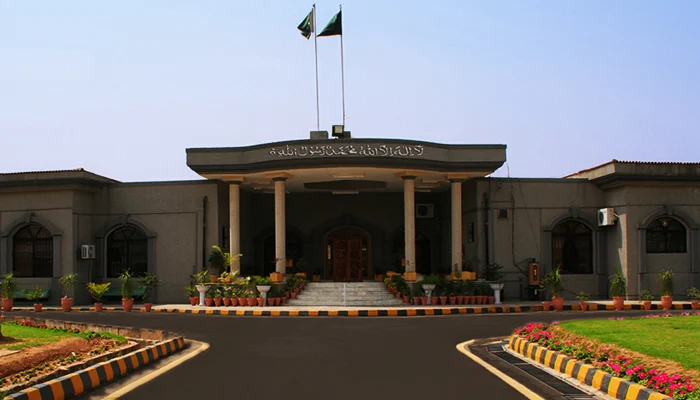

ISLAMABAD: Islamabad High Court today stopped IHC Judge Justice Tariq Mahmood Jahangiri from performing judicial duty. The IHC bench led by IHC chief justice Sarfaraz Dogar announced the verdict today. The IHC bench said that IHC Judge Jahangiri would not perform his duty till the final decision by the Supreme Judicial Council.
The Islamabad High Court (IHC) heard a petition challenging the appointment of Justice Tariq Mahmood Jahangiri. Advocate Mian Dawood filed the petition under Article 199 of the Constitution. He questioned the validity of Justice Jahangiri’s LLB degree from the University of Karachi.
A two-member bench, headed by Chief Justice Sardar Mohammad Sarfraz Dogar and comprising Justice Mohammad Azam Khan, conducted a hearing of the matter. The hearing is scheduled for September 16. Previously, former IHC Chief Justice Aamer Farooq had reserved judgment on the petition’s maintainability.
The court also appointed two senior lawyers as judicial assistants in the case: Barrister Zafarullah Khan and former Attorney General Ashtar Ausaf.
Their role will be to provide legal insights and assist the bench in navigating the matter.
In addition, the IHC issued a notice to the Attorney General of Pakistan, seeking his assistance on the admissibility of the petition.
Allegations Surrounding Law Degree
The petition alleges that Justice Jahangiri’s degree is “invalid.” It cites official correspondence from the University of Karachi as evidence. The petitioner also claimed dual enrollment numbers appeared on Jahangiri’s records. According to university rules, issuing two enrollment numbers for one programme is impossible.
The petition highlights that enrollment number AIL-5968/87, appearing on Jahangiri’s Part-I mark sheet, belongs to another student. Official records show the number was assigned to Imtiaz Ahmad, son of Muhammad Ellahi.
Furthermore, a letter from the principal of Government Islamia Law College, Karachi, stated that no student named Tariq Mehmood under enrollment AIL-7124/87 was admitted during the relevant period. Additionally, the Controller of Examinations confirmed in writing that the documents in question were “invalid.”
Petition Cites Fundamental Rights and Judicial Integrity
The petitioner argues that appointing a judge without a valid degree undermines citizens’ fundamental rights. He emphasized that such an appointment erodes public trust in the judiciary. Referring to earlier cases, he claimed the issue “shakes public confidence” and “tarnishes the judiciary’s image.”
Context of Justice Jahangiri’s Career
Justice Jahangiri is one of five judges who earlier opposed the transfer of Justice Dogar and two colleagues. Last year, he co-authored a letter to the Supreme Judicial Council, alleging interference by intelligence agencies in judicial matters. Moreover, he was hearing high-profile election petitions in Islamabad shortly before the degree controversy surfaced.
This story will be updated further:
