

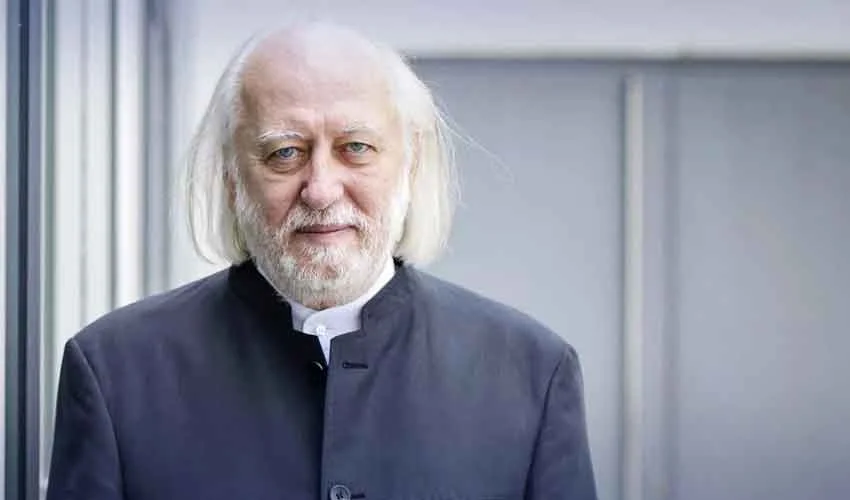

Hungarian writer László Krasznahorkai has been awarded the 2025 Nobel Prize in Literature, recognized for his “compelling and visionary oeuvre that, in the midst of apocalyptic terror, reaffirms the power of art,” the Swedish Academy announced on Thursday.
Known for his dense, philosophical prose and bleakly poetic settings, Krasznahorkai becomes the second Hungarian to win the prestigious award after Imre Kertész in 2002.
A Master of Apocalyptic Fiction and the Absurd
The Swedish Academy hailed Krasznahorkai as a major epic voice in Central European literature, comparing his work to that of Franz Kafka and Thomas Bernhard, known for their grotesque, absurdist portrayals of modern life.
His novels often move from Hungary’s desolate villages to the urban gloom of post-communist Europe, before shifting eastward to China and Japan, countries that deeply influenced his style and themes after years of travel.
“Krasznahorkai is not only a chronicler of Central European despair,” the Academy noted, “but also a contemplative voice shaped by Eastern philosophy.”
American writer Susan Sontag once described him as “literature’s master of the apocalypse,” a title earned after she read his 1989 novel The Melancholy of Resistance.
From Rural Hungary to Global Acclaim
Born in Gyula, near the Romanian border, Krasznahorkai rose to prominence with his debut novel, Satantango (1985), set on a dying collective farm. The novel explores the collapse of hope in a decaying society, echoing the fall of communism.
“Everyone in the novel is waiting for a miracle — one that never comes,” the Academy said, referencing a Kafka quote that opens the book.
Kafka is a constant influence for Krasznahorkai. “When I am not reading Kafka, I am thinking about Kafka. When I am not thinking about Kafka, I miss thinking about him,” he said in a 2013 interview.
Screen Adaptations and Critical Success
Krasznahorkai is also known for his collaborations with Hungarian filmmaker Béla Tarr, who adapted Satantango into a seven-hour cinematic epic. Other adaptations include The Werckmeister Harmonies, earning both men global acclaim for their portrayal of existential despair.
“When I read Satantango, I knew immediately I had to make a film,” Tarr said after the Nobel announcement.
Krasznahorkai’s haunting narratives resonate powerfully in today’s world, reflecting the violence, uncertainty, and absurdity witnessed in conflicts like the Russia-Ukraine war and the Israel-Palestine crisis.
“His work may feel even more relevant now than before,” said Jason Whittaker, professor at the University of Lincoln. “In a darker 21st century, his bleak but brilliant storytelling speaks to a broader audience.”
A Controversial but Celebrated Literary Prize
The Nobel Prize in Literature, worth 11 million Swedish crowns (approx. $1.2 million), is the fourth Nobel to be announced in 2025. It follows a long tradition of honoring writers whose work pushes artistic and cultural boundaries.
Past winners include William Faulkner, Winston Churchill, Orhan Pamuk, and Jon Fosse. In 2024, Han Kang became the first South Korean and 18th woman to receive the prize.
However, the prize has often drawn criticism — from awarding Bob Dylan in 2016 to honoring Peter Handke in 2019 despite his controversial political stances.
Even literary giants like Tolstoy, Zola, and Joyce were never selected, sparking ongoing debate about the prize’s legacy.
But in 2025, few could argue against the choice of Krasznahorkai — a writer whose work confronts the chaos of the modern world while reminding readers of literature’s enduring power.
