

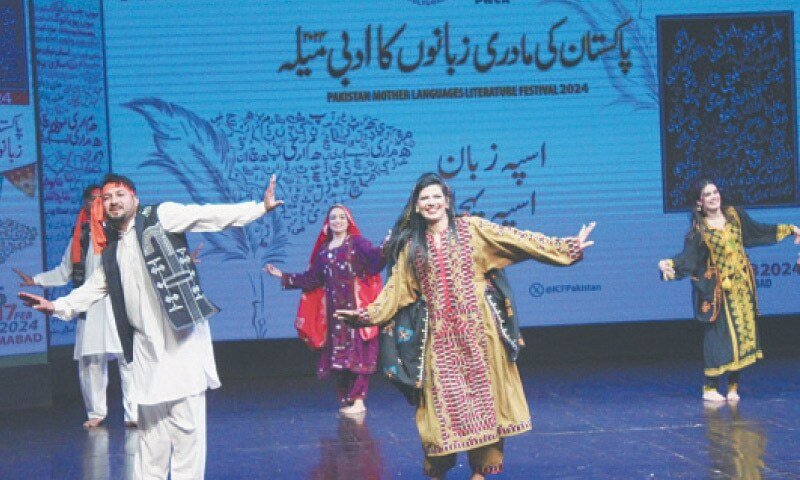

The Pakistan Mother Languages Literature Festival 2026 entered its second day in Islamabad, celebrating linguistic diversity at the Pakistan National Council of the Arts. Yet speakers cautioned that many languages and artistic traditions are at risk of disappearing.
The programme featured discussions, performances, and literary reflections. First, a major session honoured influential writers of regional languages. Representatives of Brahui, Seraiki, Punjabi, Urdu, Balochi, Sindhi and Potohari joined the dialogue. Meanwhile, scholars representing Gojri, Pahari, Hindko and Gawarbati also shared insights.
Speakers stressed the urgent need for institutional support. They said recognition alone cannot protect linguistic heritage. Therefore, policymakers must strengthen education in native languages. Without structured support, many languages could gradually weaken.
Brahui poet Tahira Ehsaas Jattak shared her personal journey. She recalled her struggle for education in Khuzdar. She noted that she was once the only girl in her school. Today, she sees more girls studying. However, she questioned whether children still dream in their mother tongues.
Participants emphasized that many schools still rely heavily on dominant languages. Consequently, children often lose early connection with native speech. Although authorities introduced local language programmes in recent years, progress remains slow. Speakers said trained teachers and institutional backing remain limited.
Balochi scholar Abdul Saboor Baloch also addressed the gathering. He described his academic journey and research contributions. He highlighted growing interest in Balochi studies. However, he stressed that passion alone cannot preserve languages. He urged strong policy frameworks and educational reforms. He previously led research initiatives linked to the University of Balochistan.
Endangered Instruments Reflect Wider Cultural Risks
Later, the festival shifted focus to traditional arts and musical heritage. The session opened with a documentary supported by UNESCO. The film explored the boreendo, an ancient clay wind instrument from Sindh. The screening set a reflective tone for the discussion.
Filmmaker Jawad Sharif shared observations from his research on endangered instruments. He noted generational shifts in musical preferences. For example, young musicians increasingly choose modern instruments over traditional ones. As a result, older art forms face gradual decline.
Salman Tahir from the Citizens Archive Pakistan highlighted the importance of contextual preservation. He explained that cultural heritage includes knowledge, history and lived experience. Therefore, documentation must capture social realities as well as artistic forms.
Speakers also emphasized economic sustainability. They argued that artists cannot preserve traditions without financial stability. Consequently, cultural survival depends on livelihood opportunities. Many participants agreed that preservation must support communities, not just archives.
Author Gulzar Gichki discussed the soroz, a traditional Balochi instrument. He described it as a carrier of poetry, memory and healing traditions. However, the number of practitioners continues to decline. Youth activist Raaziq Faheem highlighted training programmes in Balochistan. He encouraged integrating traditional music into modern cultural spaces.
Festival Calls for Innovation to Sustain Cultural Identity
Across sessions, participants presented a unified message. Cultural heritage must adapt to survive in a modern world. Speakers encouraged collaboration among universities, cultural organizations and communities. They urged long-term strategies for preservation.
The festival concluded with participants stressing their responsibility to preserve languages and musical traditions as living cultural identities. They highlighted education, policy, and innovation as key tools to sustain cultural heritage, emphasizing both urgency and hope.
