

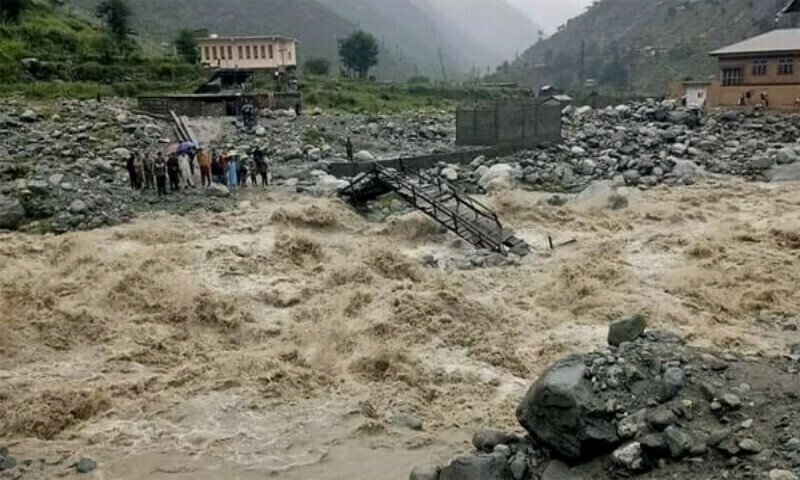

In Swat’s Mangalore area of Khyber Pakhtunkhwa, a catastrophic flood swept into a government primary school on Saturday, but the headmaster’s swift action prevented what could have been a national tragedy.
Headmaster Saeed Ahmed noticed water levels rising rapidly in a nearby stream early that morning. Without hesitation, he instructed teachers to allow all 936 students to go home immediately. Just minutes later, floodwaters surged into the school, toppling its boundary wall and submerging classrooms and offices within five minutes. Thanks to his timely decision, every student was safely evacuated before the deluge struck.
Standing among the wreckage, Ahmed appealed to authorities to rebuild the school so children could continue their studies. “The flood destroyed our classrooms, but we saved our children. Now, the government must help us bring them back to education,” he told reporters.
Nationwide, the flooding has taken a devastating toll. Rescuers in Khyber Pakhtunkhwa and Gilgit-Baltistan dug through rubble and massive boulders on Sunday, searching for survivors after landslides and flash floods buried homes. The official death toll has crossed 650, with more than 920 injured, and at least 300 fatalities reported in KP, GB, and Azad Jammu and Kashmir alone.
Mass funerals were held across the region, with rows of bodies wrapped in blood-stained white shrouds laid out for mourning communities. Fallen trees, collapsed houses, and fields covered in mud painted a grim picture of destruction.
The Pakistan Meteorological Department has warned that monsoon activity is likely to intensify, with “torrential rains” forecast in the coming days. Officials estimate this year’s monsoon to be 50–60% stronger than last year, with more heavy spells expected through early September.
International voices of solidarity have also emerged. Iran offered assistance to help flood victims, while Pope Leo XIV extended prayers for those suffering across Pakistan.
The annual monsoon provides vital rainfall for South Asia’s agriculture, but in Pakistan, its increasingly destructive intensity continues to expose the country’s vulnerability to climate extremes.
