

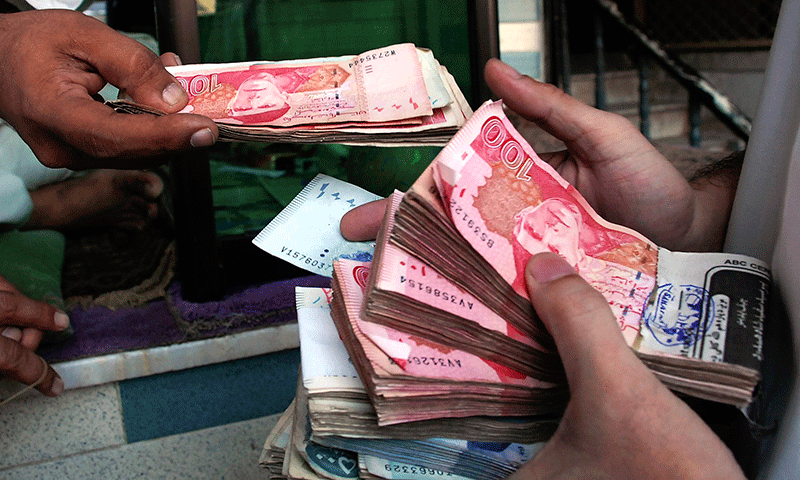

In a significant policy shift aimed at curbing cash-based transactions, the federal government is poised to introduce a dual pricing mechanism and differential tax rates for cash and digital payments across various sectors in the upcoming budget.
One of the key proposals includes charging an additional Rs2 to Rs3 per litre for fuel purchases made in cash, while maintaining the standard rate for digital payments. All petrol stations nationwide will be legally required to offer digital payment methods such as QR codes, debit and credit cards, and mobile wallet services.
This broader digital push will also apply to manufacturers and importers, who may be obligated to charge an extra 2% general sales tax (GST) on cash transactions—over and above the standard 18% GST applied to digital payments.
The government’s new strategy—described as a “war on cash”—aims to gradually transition Pakistan’s economy from a predominantly cash-based model to a more transparent, cashless one. Finance Minister Muhammad Aurangzeb is expected to formally unveil these proposals during his budget speech on June 10.
To support this shift, policymakers are actively collaborating with the Federal Board of Revenue (FBR), the Ministry of Petroleum, financial institutions, and consulting firms. The objective is to create an ecosystem where digital transactions are easier, more cost-effective, and increasingly incentivised.
An official familiar with the plans said that regulated fuel pricing for digital payments would be a manageable starting point, adding that the system would also help track fuel supplies across the country—from borders and ports to refineries and retail outlets.
Businesses and consumers will retain the choice to use cash but must be prepared to pay higher taxes or prices. “If retailers and their customers choose to absorb these extra costs, it’s their decision, but it won’t be economical,” the official said.
The move also comes with a minor relief for the salaried class, as the upcoming budget may introduce a slight reduction—between 1 and 1.5 percentage points—in income tax rates, reflecting the government’s intent to ease the burden on documented earners.
The Finance Bill 2025-26 is expected to mandate that every business—regardless of size—offer both cash and digital payment options, with cash payments carrying a surcharge. The government aims to promote cost-effective digital solutions like QR codes over more expensive point-of-sale (POS) systems.
Countries like India, Bangladesh, and Indonesia have seen considerable success with such transitions, and Pakistan aims to replicate similar results.
Despite previous efforts, the FBR has been largely unsuccessful in documenting cash-heavy sectors such as event planning, jewellery, wedding halls, private clinics, and salons. Finance Minister Aurangzeb has pledged to shift the tax burden away from the salaried and compliant sectors toward those currently outside the tax net.
In public statements, the minister emphasised the need for aggressive digitisation to access the estimated Rs9.3 trillion in cash circulating within the economy. He highlighted that around Rs1.3 trillion in taxes is evaded by non-filers and under-filers, and stressed that joining the ranks of major global economies like the G20 would require a comprehensive move towards documented transactions.
He also noted that Pakistan’s economy could be worth over $700 billion—far beyond the currently reported $410 billion—pointing to more than Rs7 trillion in potential annual tax evasion.
On the petroleum front, the government recently introduced a bill in the National Assembly aimed at digitally tracking fuel from import and production to end-user sales. The initiative seeks to curb smuggling and adulteration—practices that result in annual losses of Rs300–500 billion and environmental degradation.
The upcoming dual pricing policy for fuel is expected to reinforce this digital tracking system and help ensure complete traceability throughout the fuel supply chain.
