

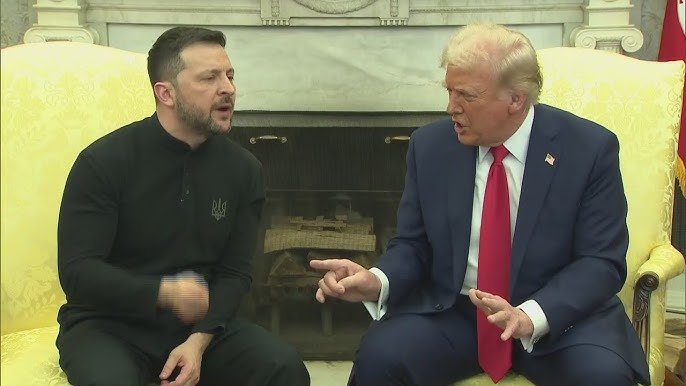

A high-stakes meeting between Ukrainian President Volodymyr Zelenskyy and former US President Donald Trump in Washington took an unexpected turn on Friday, leading to a heated exchange over the ongoing war with Russia.
During the tense Oval Office discussion, Trump and his running mate, JD Vance, criticized Zelenskyy for what they described as a lack of appreciation for US military and financial assistance.
“You’re gambling with the lives of millions,” Trump reportedly told Zelenskyy. “You’re risking World War III, and what you’re doing is very disrespectful to this country.”
Zelenskyy, who had traveled to Washington seeking security guarantees in the event of a ceasefire, pushed back against Trump’s remarks, firmly rejecting any negotiations with Russian President Vladimir Putin on Moscow’s terms.
“There will be no compromises with a killer on our land,” Zelenskyy stated.
Following the exchange, Zelenskyy departed from the White House. Trump later took to his social media platform, Truth Social, to assert that Zelenskyy was unwilling to pursue peace if it involved US mediation.
“He disrespected the United States in its own Oval Office. He can return when he is ready for peace,” Trump wrote.
Zelenskyy responded on X (formerly Twitter), expressing gratitude for US support while reaffirming Ukraine’s commitment to achieving a “just and lasting peace.”
Russia Welcomes Trump’s Position
Moscow swiftly reacted to the confrontation, interpreting it as a diplomatic win. Dmitry Medvedev, deputy head of Russia’s Security Council, described Trump’s remarks as a “firm reprimand” for Ukraine.
“For the first time, Trump told the cocaine clown the truth to his face: The Kyiv regime is playing with the Third World War,” Medvedev wrote on Telegram.
Maria Zakharova, spokesperson for Russia’s Foreign Ministry, echoed this sentiment, labeling Zelenskyy a “scumbag” and accusing him of misrepresenting Ukraine’s international backing.
European Leaders Stand by Ukraine
Meanwhile, European officials strongly condemned Trump’s statements and reaffirmed their commitment to Ukraine.
European Commission President Ursula von der Leyen expressed solidarity with Zelenskyy, writing on X: “Your courage reflects the resilience of the Ukrainian people. Stay strong.”
Kaja Kallas, the European Union’s foreign policy chief, suggested that the world needed fresh leadership to champion Ukraine’s cause.
“Today made it clear—the free world requires new leadership,” Kallas stated. “Europe must rise to the challenge.”
French President Emmanuel Macron reiterated that Russia remains the aggressor in the conflict, while German Chancellor Olaf Scholz assured Ukraine of continued European support.
“The images from the White House are alarming,” said German lawmaker Johann Wadephul. “How can one undermine the leader of an invaded nation? Free Europe will not abandon Ukraine.”
Mixed Reactions from the UK, Canada, and Australia
British Prime Minister Keir Starmer held separate discussions with both Trump and Zelenskyy following their dispute, later reaffirming the UK’s commitment to Ukraine’s sovereignty and security.
Canadian Prime Minister Justin Trudeau stressed that Ukraine’s fight against Russian aggression is “a battle that concerns us all.”
Australian Prime Minister Anthony Albanese similarly pledged that Australia would support Ukraine “for as long as necessary.”
Eastern Europe Divided on Trump’s Comments
Polish Prime Minister Donald Tusk reassured Ukraine that it was “not alone,” while Estonian Foreign Minister Margus Tsahkna warned that “if Ukraine stops fighting, there will be no Ukraine.”
However, Hungarian Prime Minister Viktor Orban voiced support for Trump’s approach, praising his stance on diplomacy.
“Strong leaders make peace, weak ones make war,” Orban posted on X. “President Trump stood courageously for peace today.”
Shifting Alliances and Uncertain Future
The Oval Office confrontation has intensified concerns over the future of US support for Ukraine, particularly with Trump leading the race in the upcoming presidential election.
As divisions among Western allies deepen, analysts suggest that the fallout from this meeting could significantly influence the course of the war in the coming months.
